
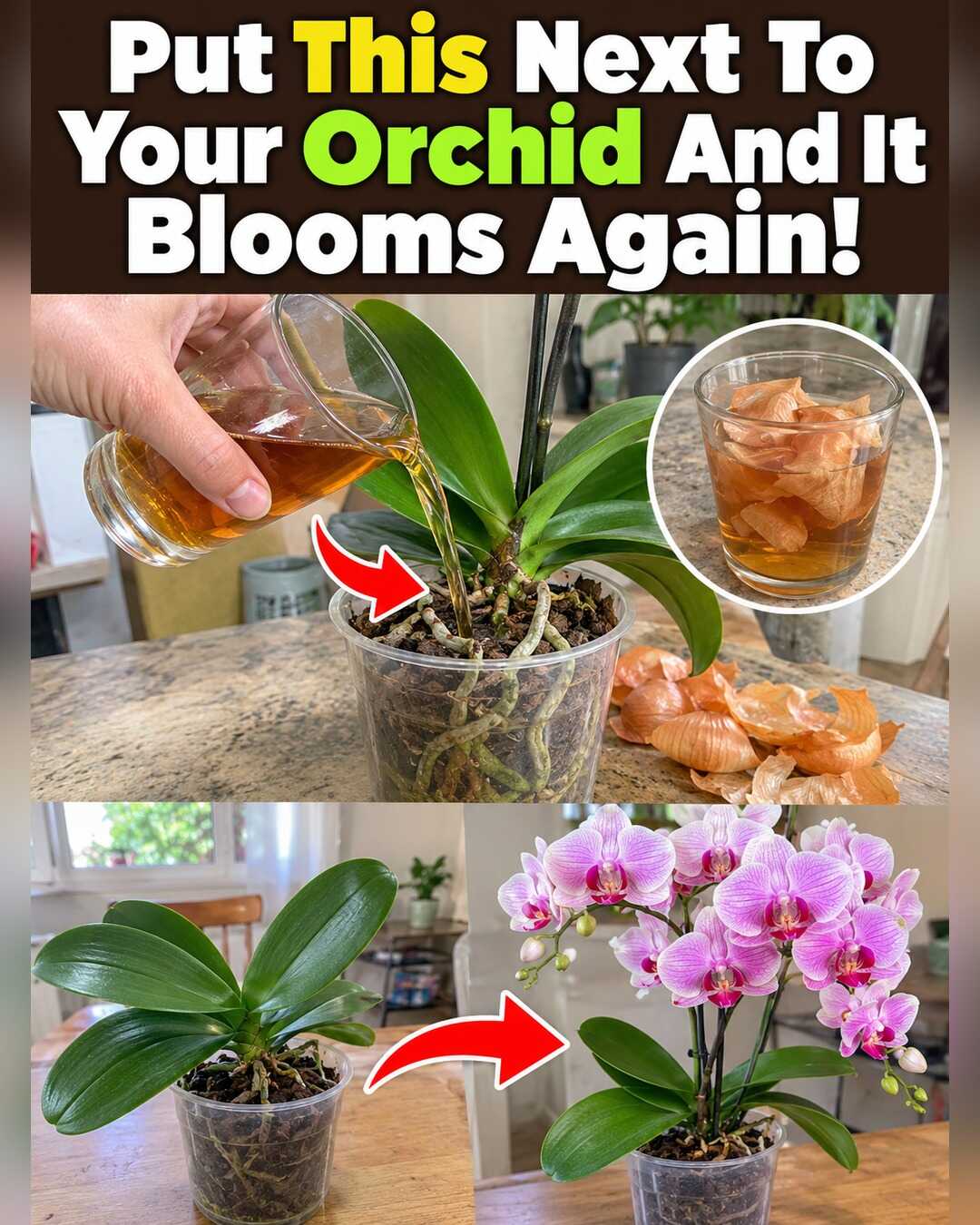
Put THIS Next to Your Orchid and It Blooms Again!
The “this” in the title is onion skins. The dry, papery outer layers you usually throw away can be steeped into a pale amber tea, and a small glass of it, once every few weeks, is a favorite home trick among Phalaenopsis orchid growers who want their plant to bloom again. It is free, it takes five minutes, and it uses something that would end up in the trash.
Many people buy a beautiful orchid, enjoy the flowers for a few months, and then wait. And wait. The leaves stay green but the flower spike never comes back. In this guide you will learn how to make onion skin tea, how much to use, how often, and the mistakes to avoid so your orchid has its best chance to rebloom.
Why onion skins for an orchid?
Onion skins are rich in natural plant compounds, including quercetin, the pigment that gives them their golden color. Gardeners have used onion skin water on houseplants for generations as a mild, natural “tonic”.
- Very gentle. The tea is weak, so it will not burn the delicate, silvery roots of an orchid the way strong fertilizer can.
- A little extra nutrition. The skins release small amounts of potassium and other minerals into the water.
- Helps keep the roots happy. Many growers like it as part of a routine that keeps roots firm and green.
Keep your expectations realistic: onion skin tea is a gentle helper. Orchids rebloom mostly because of light and temperature, and the tea works best when those are right too.
What you need
- The dry outer skins of 2 to 3 onions (yellow or brown)
- 2 cups (500 ml) of water
- A small pot and a strainer
- A glass or jar
How to make onion skin tea
- Rinse the dry onion skins quickly under the tap.
- Bring 2 cups of water to a boil, add the skins, and turn off the heat.
- Cover and let it steep for 30 minutes, until the water is a light amber color.
- Strain out the skins. Let the tea cool completely to room temperature.
- Dilute it with an equal amount of plain water, so it is half tea and half water.
The tea should look like weak iced tea, never dark brown. If it is very dark, add more water. Use only the dry outer skins, with no salt, oil or anything else.
How to use it on your orchid
- Water your orchid only when the potting bark is nearly dry and the roots look silvery.
- Pour about 1 glass (around 1 cup, 250 ml) of the diluted tea slowly over the bark, around the base of the plant.
- Let the water run through the pot for a minute.
- Empty the cachepot or saucer after 15 minutes. Orchid roots must never sit in water.
- Repeat once every 3 to 4 weeks, replacing one normal watering with the tea.
Avoid pouring tea into the center of the leaves, where water can collect and cause crown rot. Aim for the bark and roots.
What to expect and when
- After 3 to 4 weeks: roots look plumper and leaves firm and glossy.
- After 2 to 3 months: a new root or leaf often appears.
- After 3 to 6 months: with enough light and a cooler night, many orchids send up a new flower spike.
Phalaenopsis orchids usually need a drop in night temperature of about 10 degrees F (5 degrees C) in autumn to set a spike. A spot near a bright window, with cooler nights, makes a big difference.
Mistakes to avoid
- Using hot tea. Always let it cool completely, as hot liquid damages roots.
- Making it too strong. Strong tea can stain the roots and leave residue on the bark.
- Using it every week. Once every few weeks is enough.
- Keeping leftovers. The tea spoils in a few days. Make a fresh batch each time.
- Letting water sit in the crown. Dry the center of the plant with a paper towel if water gets in.
Bonus tips to help an orchid rebloom
- Give it bright, indirect light, such as an east-facing window.
- Cut the old spike just above the second node (the small bump) after flowers fade, if the spike is still green.
- Use a clear pot so you can see when roots turn silver and it is time to water.
- Do not move the plant often. Orchids dislike sudden changes.
- Ice cubes are not necessary. Normal room-temperature water is better for roots.
How to know your orchid is ready to rebloom
A Phalaenopsis orchid is ready to flower when it has at least four or five healthy, firm leaves and a few plump, silvery-green roots. Floppy, wrinkled leaves are a sign of thirsty or damaged roots, and in that case the plant needs recovery before it can bloom.
Look at the roots through the clear pot. Green tips mean active growth, and that is exactly what you want. Brown, mushy roots should be trimmed with clean scissors. After a rest of a few months, a healthy plant often sends out a thin green spike from between the leaves, close to the base.
When you see that spike, stop moving the plant and keep watering regularly. Do not turn the pot, because the spike grows toward the light and a change can cause it to twist or stop. Keep the onion skin tea going once every few weeks while the spike grows.
Frequently asked questions
Can I use red onion skins?
Yes. Red and yellow onion skins both work. Red skins give a slightly pinker tea. Use the same amounts and dilute it the same way. Avoid skins that are moldy or soft.
Do I need to boil the skins?
Steeping in hot water pulls out more from the skins, so it is the easiest method. If you prefer, soak the skins in cool water overnight. It will be a bit weaker, but still fine to use.
How long can I store the onion tea?
Not long. Use it the same day, or keep it in the fridge for up to two days. If it smells sour or looks cloudy, throw it out and make a new batch for your orchid.
Will it stain my orchid’s leaves or pot?
Diluted tea can leave a light yellow tint on white pots or on a windowsill. Wipe any splashes quickly with a damp cloth. It does not harm the leaves, but keep it off the flowers.
Why is my orchid still not blooming?
The two most common reasons are too little light and no night-time temperature drop. Check that the leaves are bright green, not dark. Give it a few weeks near a brighter window and be patient.
Can I use it on other houseplants?
Yes, diluted onion skin tea is generally mild enough for most houseplants. Just remember that orchids need a bark mix and very good drainage, so always let the water run through.
Next time you peel an onion, save the skins. This simple habit costs nothing and may be the push your orchid needs to bloom again.