
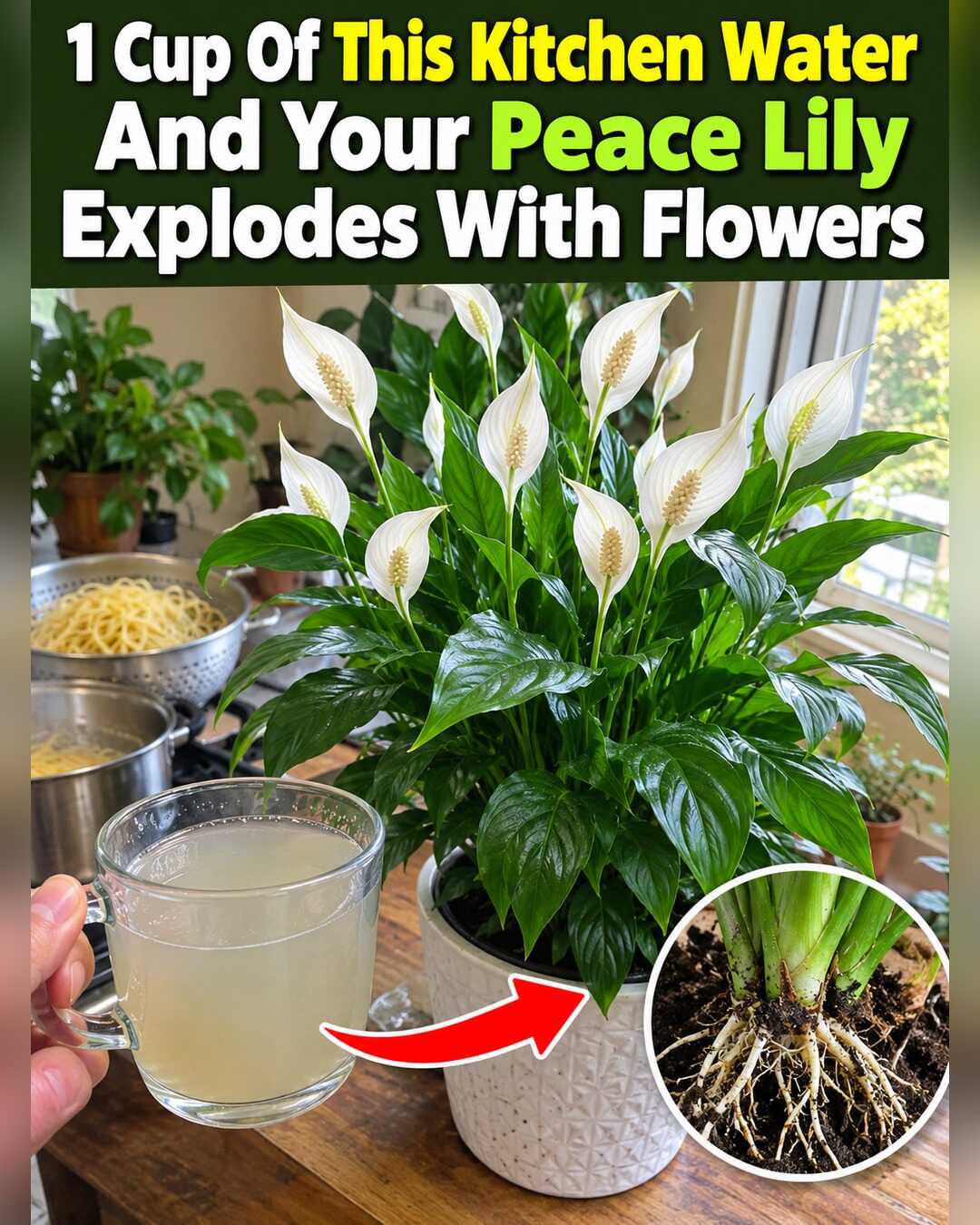
1 Cup of This Kitchen Water and Your Peace Lily Explodes With Flowers
The “kitchen water” in the title is cooled pasta cooking water, the starchy water you usually pour down the sink. Let it cool completely, make sure it has no salt, and give your peace lily about one cup once a month. Many plant lovers say it helps the plant produce more white blooms. It is free and takes only a minute.
The peace lily (Spathiphyllum) is a favorite because it tolerates low light, but a lot of owners end up with a plant that has beautiful dark leaves and few or no flowers. In this guide you will see how to prepare the water, how much and how often to use it, and what to avoid so you do not harm your plant.
Why pasta water for a peace lily?
When pasta boils, starch and small amounts of minerals pass into the water. Once the water is cool and unsalted, it becomes a very mild “snack” for houseplants.
- A little starch for the soil. It feeds the beneficial microbes in the potting mix, which help roots absorb nutrients.
- Trace minerals. The water carries small amounts of potassium, phosphorus and magnesium, nutrients that flowering plants use.
- Totally free. You reuse water that would be thrown away.
It is not a miracle fertilizer. Peace lilies bloom best with good light and steady watering, and the pasta water is a gentle helper on top of that.
What you need
- 1 cup (250 ml) of pasta cooking water per plant
- A jar or measuring cup
- Plain, unsalted pasta water
This is the important part: salt damages the roots and leaf tips of a peace lily. If you salt your pasta water, use the trick with water from a pot cooked without salt, or simply skip it.
How to prepare it
- Cook pasta in plain water, with no salt, oil, sauce or herbs.
- Scoop out about 1 cup of the water before you drain the pasta.
- Let it cool completely to room temperature, at least 30 to 60 minutes.
- If the water is very thick and cloudy, dilute it with a little plain water.
How to use it step by step
- Check the soil. Water when the top inch (2.5 cm) feels dry to the touch.
- Slowly pour 1 cup of the cooled pasta water over the soil of a 6-inch pot.
- Pour evenly around the base of the plant, not on the leaves or flowers.
- Let it drain for 10 to 15 minutes, then empty the saucer.
- Repeat once a month. In between, water normally with plain water.
Use it the same day. Starchy water starts to smell sour after a day, and the soil can turn smelly if you use too much.
What to expect and when
- After 2 to 3 weeks: deeper green, glossy leaves.
- After 1 to 2 months: new leaves and sometimes small flower stalks coming up from the center.
- After 2 to 3 months: with enough bright, indirect light, many peace lilies produce white spathes.
Peace lilies bloom mostly in spring and summer, but a healthy plant in a bright room can flower on and off almost all year.
Mistakes to avoid
- Using salted water. This is the biggest mistake. Salt burns roots and causes brown tips.
- Using hot water. Always cool it down fully.
- Using it too often. Once a month is enough. Too much starch can make the soil sticky.
- Using water with oil or sauce. Oil coats the roots and blocks air.
- Letting the pot sit in water. Soggy roots lead to yellow leaves and rot.
Bonus tips for more flowers
- Place the plant in bright, indirect light. Deep shade gives leaves but few flowers.
- Wipe the leaves with a damp cloth every few weeks so they can absorb light.
- Use a pot that is only slightly larger than the root ball. Peace lilies bloom better when a bit snug.
- If the leaves droop, water. They perk up within hours when thirsty.
- Keep it away from cold drafts and keep the room above 60 degrees F (16 degrees C).
Watering a peace lily the right way
Good watering habits matter more than any trick. Peace lilies like soil that is evenly moist but never soaked. Stick your finger into the soil: if the top inch feels dry, water slowly until a little water drains from the bottom, then empty the saucer.
If your tap water is very hard or chlorinated, leave a filled jug out overnight before using it, or use filtered water. This helps prevent brown tips on the leaves. Dust on the leaves also blocks light, so wipe them gently with a damp cloth once a month.
Combine these simple habits with the monthly cup of cooled, unsalted pasta water and bright, indirect light. Together they give the plant everything it needs to produce its white flowers, and they are all easy to do at home.
Frequently asked questions
Can I use pasta water with salt in it?
No. Salt builds up in the soil and burns the roots and leaf tips. If your pasta water has salt, do not use it on plants. Cook a small pot without salt for your plants, or use another method.
How much pasta water does a peace lily need?
One cup for a standard 6-inch pot, once a month, is enough. Use half a cup for a small pot and up to two cups for a large floor pot. Always pour slowly so the soil can absorb it.
Can I store pasta water in the fridge?
It is best to use it fresh. In the fridge it keeps for a day, but it turns sour quickly. Never use water that smells off or looks slimy on your plant.
Does pasta water attract gnats or pests?
Starchy water can attract fungus gnats if the soil stays wet. Always let the top of the soil dry between waterings, and use only one cup a month to avoid the problem.
Why are the leaf tips of my peace lily brown?
Brown tips are usually caused by dry air, minerals in tap water, salt, or too much fertilizer. Switch to filtered or rested water, avoid salted water, and mist or humidify the room.
Does it work for other plants?
Cooled, unsalted pasta water is mild enough for most houseplants and herbs. Use the same one-cup-a-month rhythm and always check that the soil drains well afterwards.
Next time you cook pasta, save a cup of unsalted water for your plant. It is a simple, free habit that might be the nudge your peace lily needs to flower.