
🌸African Violet Not Blooming? Give It Just 1 Cup! Watch What Happens!
🌸African Violet Not Blooming? Give It Just 1 Cup! Watch What Happens!
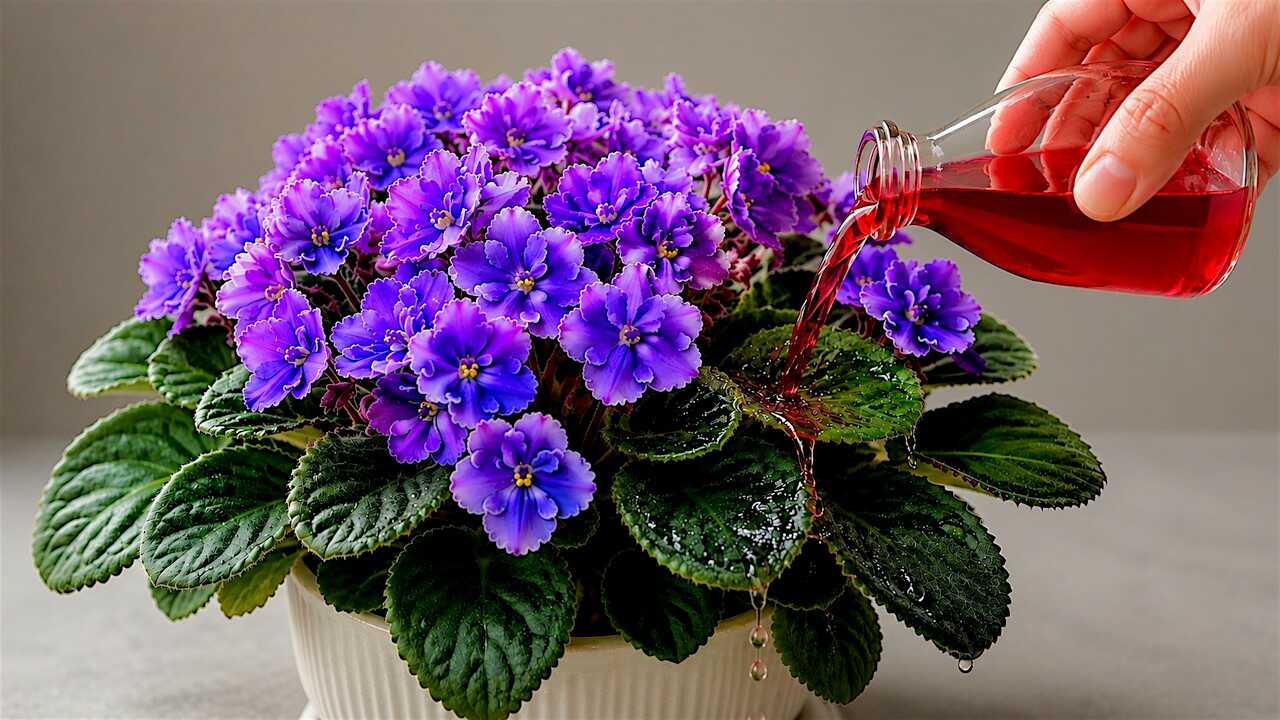
The photo shows a clear bottle pouring a red liquid near a healthy violet — that red liquid is best interpreted as a **diluted liquid fertilizer** (many houseplant fertilizers are dyed). If your African violet has leaves but no flowers, a careful, weak dose of the right liquid fertilizer can trigger bud set when combined with proper care. Below is a practical, evidence-based method using that very liquid — safely and precisely.
Why a weak liquid fertilizer helps
Phosphorus and an adequate balance of nitrogen and potassium are proven to support flower initiation and development in flowering houseplants. A low-strength, water-soluble fertilizer supplies immediately available nutrients that young flower buds can use. This is a supplement — not a cure — and works only if light, water, soil and temperature are already appropriate.
What you’ll need (and why)
- Water-soluble fertilizer labeled for houseplants or flowering plants (if possible a bloom formula with higher P like a 10-30-10, or a balanced 20-20-20). Choose a reputable brand and follow label safety.
- Room-temperature water (cold water can shock roots).
- A measuring 1/8 teaspoon measure or a small scale, and a 1-cup (240 mL) measuring cup.
- A saucer or tray under the pot for bottom-watering (recommended).
Precise recipe and schedule — do this exactly
Prepare a single, weak dose before each feeding:
- Mix 1/8 teaspoon (≈0.6 mL) of water-soluble fertilizer into 1 cup (240 mL) of room-temperature water. Stir until fully dissolved.
- Place the potted African violet on a saucer and pour the entire cup of solution into the saucer so the pot soaks up the solution from below for 15–30 minutes. Then pour away any remaining solution to avoid root saturation.
- Frequency: Every 10–14 days during the active growing/blooming season (spring and fall). In cool, low-light winter months reduce to once monthly.
Why bottom-watering?
The image shows liquid poured over leaves — do not do that with African violets. Wet leaves cause spotting and crown rot. Bottom-watering with a cup of dilute fertilizer gets nutrients to the roots while keeping leaves dry.
Step-by-step routine (quick and repeatable)
- Check light: give bright, indirect light (east or north window). Too little light = no blooms.
- Confirm soil and drainage: use a light, fast-draining African violet mix and a pot with proper drainage.
- Water normally between feedings with plain water using bottom-watering or by moistening soil without wetting leaves.
- When it’s time to feed (see schedule), mix the 1/8 tsp per 1 cup solution and apply to saucer as described.
- Deadhead spent flowers and remove damaged leaves to encourage new bud formation.
- Expect to see bud initiation and improved bloom set within 4–8 weeks if other conditions are right.
Practical tips from experience
- Use room-temperature, filtered or rainwater when possible; hard tap water can deposit salts.
- If your fertilizer label gives a recommended mix, you can also use ¼ of the label strength instead of the 1/8 tsp recipe — consistency is key.
- Maintain stable temperatures around 65–75°F (18–24°C) and moderate humidity; extreme drops or drafts hinder blooming.
- Repot lightly every 12–18 months into fresh mix — old, depleted soil holds salts and reduces flowering.
Common mistakes to avoid
- Pouring fertilizer directly onto leaves — this causes brown spots, crown rot and fungal issues.
- Feeding at full strength or too often — leads to salt burn and leaf yellowing. Never feed more frequently than every 10 days at this dilution.
- Using a high-nitrogen-only fertilizer — this promotes foliage growth at the expense of flowers. Choose a balanced or bloom formula.
- Expecting instant results — avoid claims of “a few days.” Plan for 4–8 weeks of consistent care.
When to adjust or stop
If you see leaf-tip burn, white crust on the soil surface, or slow growth, stop fertilizing for a month and flush the soil with plain water (bottom water until clear run-off). If buds drop despite feeding, check light and temperature first — nutrients can’t fix poor environmental conditions alone.
Closing motivation
That little red bottle in the photo represents a simple tool: a gentle, regular boost of readily available nutrients. Give your African violet a measured 1-cup dose of the weak fertilizer solution every 10–14 days (bottom-watered), combine it with proper light and humidity, and you should see more buds and blooms in 4–8 weeks. Try this exact routine, watch patiently, and share your results — your violet can reward you with a beautiful, lasting bloom cycle.