🌺 Just Garlic! Anthuriums Grow Strong Roots & Bloom All Year Naturally
🌺 Just Garlic! Anthuriums Grow Strong Roots & Bloom All Year Naturally
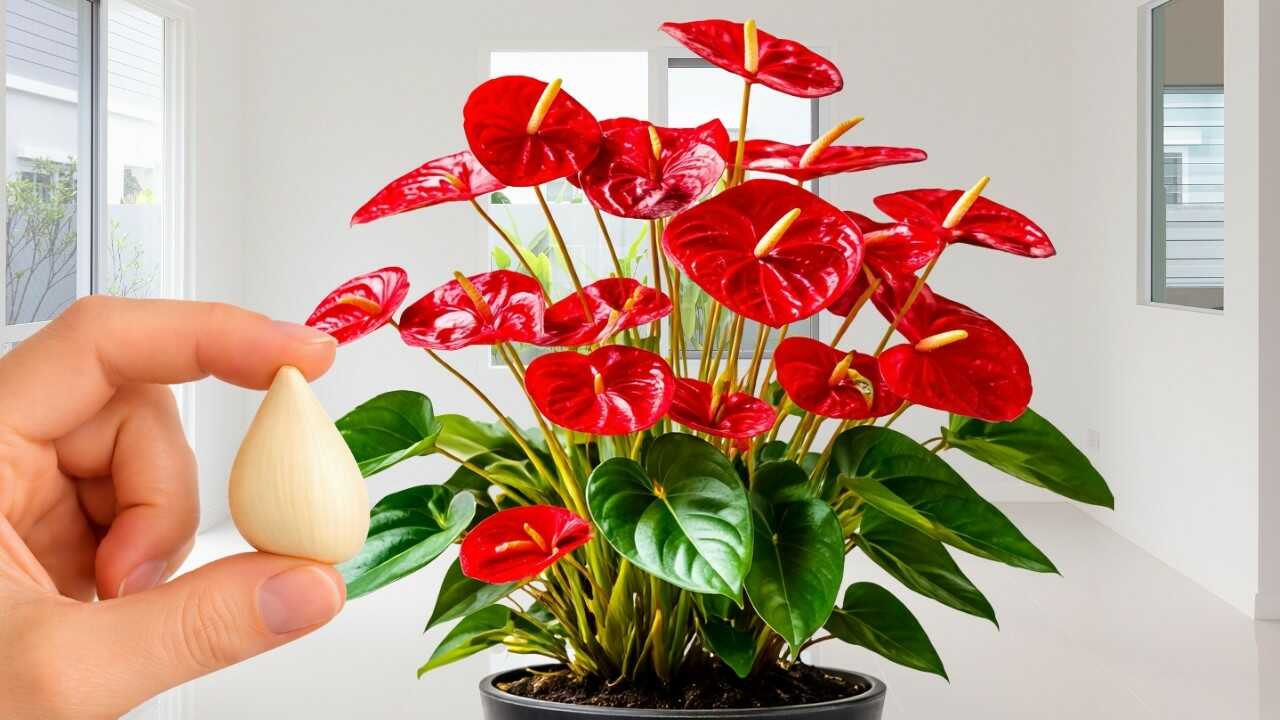
The photo shows a single peeled, teardrop-shaped garlic clove held beside a healthy red anthurium — a clear hint: that pale, smooth clove is the central trick. In practice, a properly prepared garlic extract can help anthuriums by reducing fungal pressure at the root zone and deterring common sap-sucking pests, supporting stronger roots and more consistent year-round blooms. This is a complementary, gentle treatment — not a replacement for proper light, watering, drainage, and fertiliser.
Why garlic works for anthuriums
Garlic produces sulfur-containing compounds (notably allicin) with documented antimicrobial and insect-deterrent activity. For potted anthuriums, a mild, diluted garlic extract can lower surface fungal spores and discourage small pests (aphids, spider mites) without toxic chemical residues. Garlic is not a fertilizer — it does not replace balanced N-P-K feeding — but used carefully it helps protect roots and leaves while you maintain good cultural care.
What you’ll need
- Fresh peeled garlic cloves (not garlic powder)
- Clean water (tap or filtered)
- Glass jar with lid or non-reactive container
- Fine strainer or cheesecloth
- Clean spray bottle (500–1000 ml)
- Measuring cup and small bowl for dilutions
Step-by-step: Two safe, precise methods
Method A — Root dip for repotting or new divisions
Use this when you repot, divide, or plant cuttings to reduce root-borne fungal load before planting.
- Crush 1 fresh garlic clove into 250 ml (about 1 cup) of water.
- Seal and steep at room temperature for 24 hours.
- Strain the liquid through a fine strainer or cheesecloth. This is your concentrate.
- Dilute the concentrate 1:4 with clean water (one part concentrate + four parts water).
- Briefly dip roots or bare-root plants for 5 minutes (maximum 10 minutes), then plant into fresh, well-draining mix.
- Use this dip only at repotting/division time — once per event.
Method B — Mild garlic spray (foliar + light soil drench)
Use for ongoing pest deterrence and light fungal suppression during the active growing season.
- Crush 2 fresh garlic cloves in 1 litre (1000 ml) of water; steep 24 hours in a closed jar.
- Strain carefully. Dilute the strained extract 1:10 before use (one part strained extract + nine parts water).
- Test first: spray one lower leaf and wait 48 hours to check for sensitivity.
- If safe, spray the foliage lightly (both surfaces) in the evening to avoid sun scorch. Avoid saturating the crown.
- Soil drench: for a 15–20 cm (6–8″) pot, apply 200–250 ml of the diluted spray at the pot surface every 3–4 weeks during the growing season.
- Frequency: in spring–summer, spray every 7–10 days if pest pressure is present; otherwise every 2–3 weeks. In autumn–winter, reduce to every 3–4 weeks or stop if growth has slowed.
Practical tips from experience
- Always dilute. Undiluted garlic extract can be phytotoxic; the exact dilutions above are conservative and safe for anthuriums when tested first.
- Apply in the evening or on a cloudy day to prevent leaf burn and to allow the smell to dissipate overnight.
- Use fresh garlic. Old, fermented mixtures should be discarded after 5–7 days; make a fresh batch as needed.
- Keep a record: note treatment dates and plant response. Expect gradual improvement — visible differences in pest reduction or root firmness usually appear over several weeks to a couple of months.
- Pair garlic treatments with good cultural care: bright indirect light, even humidity, water only when the top 1–2 cm of potting mix is dry, and use a balanced houseplant fertiliser during the growing season.
Common mistakes to avoid
- Using too concentrated an extract — this can damage leaves and roots. Always follow the dilutions above and do a spot test.
- Spraying in direct midday sun — risk of leaf scorch and more stress for the plant.
- Relying on garlic for advanced root rot — if you see soft, black roots with a foul smell, repot into fresh mix and consider professional fungicide options; garlic is preventative or for mild issues, not a cure-all.
- Overwatering after treatment — garlic won’t fix poor drainage. Root health depends first on correct watering and soil structure.
- Applying too often in winter — slowed growth means less need for pest sprays; over-application can stress the plant.
What to expect and timeline
When used as directed, you may notice fewer visible pests, less sticky residue on leaves, and healthier-feeling roots after several weeks to a few months. New root development and steadier, more regular blooming require consistent care — garlic is a supporting tool that reduces microbial and pest stress while you maintain proper light, humidity, fertilizer, and watering.
Conclusion — try it, watch carefully, and celebrate blooms
This simple, visual trick — a peeled garlic clove turned into a gentle extract — gives you an inexpensive, low-toxicity option to support anthurium root and foliage health. Use the exact preparations and frequencies above, pair them with solid cultural care, and observe progress over several weeks. If you try this on your anthurium, note your results and adjust conservatively — the goal is steady health and more reliable, year-round blooming.