1 Bottle a Week! Suddenly the orchid put out roots and flowers year-round
1 Bottle a Week! Suddenly the orchid put out roots and flowers year-round
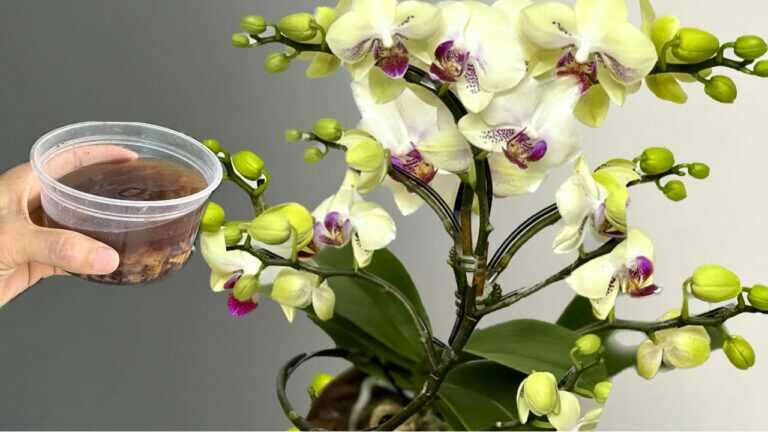
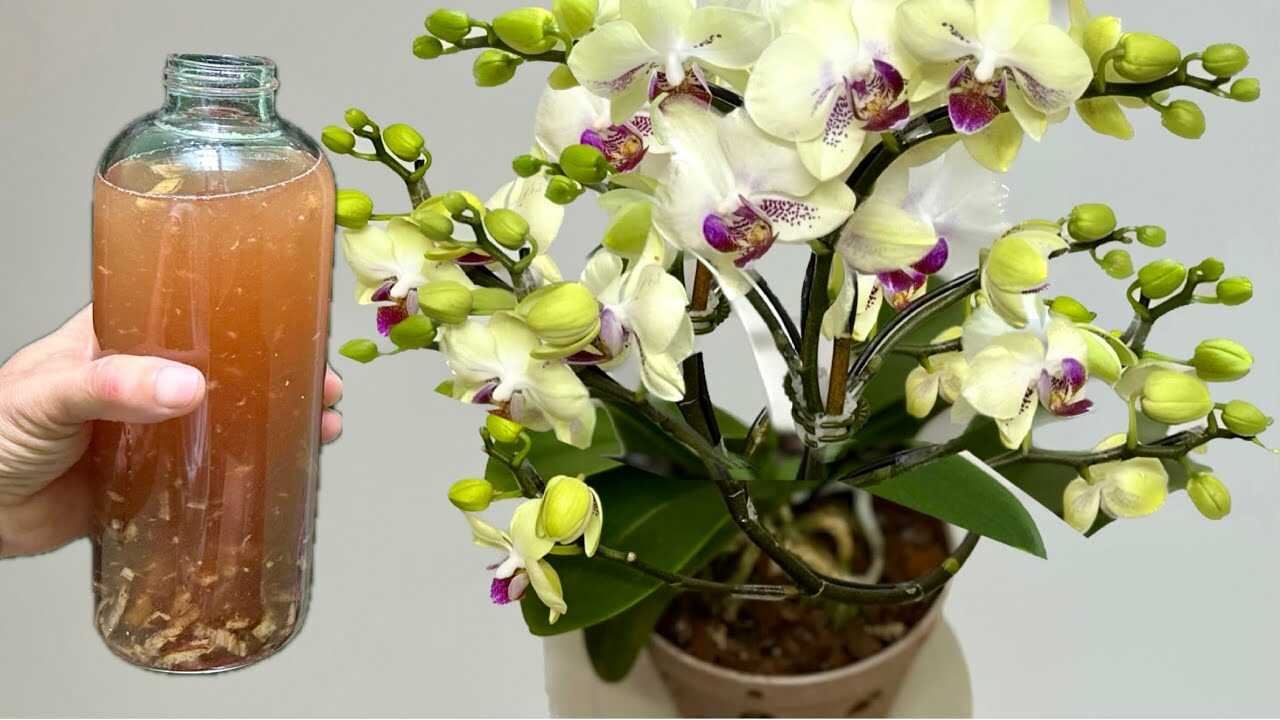
In the photo you can see a clear bottle of brown, slightly cloudy liquid with small light-brown pieces settled at the bottom — a homemade banana-peel infusion — held next to a blooming Phalaenopsis. This article shows exactly how to make and use that bottle safely on orchids so they push new roots and bloom more reliably over several weeks to months, while stressing that this is a gentle supplement to good basic care.
Why banana peels?
Banana peels are visually identifiable here as the thin, fibrous light-brown pieces in the bottle. Botanically useful reason: banana peels contain significant amounts of potassium (K) and small amounts of phosphorus, calcium and magnesium. Potassium supports flowering, water regulation and root strength in many plants, and a short cold-water infusion will leach some soluble potassium into the liquid you’ll apply. This is not a complete fertilizer — think of it as a mild, organic boost.
What you’ll need (simple and safe)
- 1 medium banana peel (organic when possible)
- 500 ml clean, filtered or boiled-and-cooled water
- 1 clean glass jar or bottle with breathable cover (or lid slightly ajar)
- Fine strainer or muslin to remove solids
- Measuring cup (100–250 ml)
Step-by-step: make the bottle exactly like in the photo
- Chop the banana peel into small pieces and place them in the glass jar.
- Pour 500 ml of cooled boiled or filtered water over the peel, leaving the jar loosely covered so gases can escape.
- Let it steep at room temperature for 48 hours (this extracts soluble potassium without heavy anaerobic rot). Do not ferment longer than 48 hours to avoid strong odors and harmful microbes.
- Strain the liquid through a fine sieve or muslin into a clean bottle; discard the solid peel into compost.
- Immediately dilute the strained infusion 1:3 (one part infusion to three parts clean water). Example: 500 ml infusion + 1.5 L water = 2 L diluted solution.
- Label the bottle with the date and use within 48 hours of dilution; refrigerate if you must keep it longer, but fresh is best.
How to apply to orchids — exact doses & frequency
Orchids, especially Phalaenopsis in bark, are sensitive to salts and excess moisture. Follow these precise rules:
- Spring–Summer (active growth): Give a 150 ml pot drench of the diluted solution per medium Phalaenopsis (12–15 cm pot) once per week. This matches the “1 bottle a week” habit if you prepare a 500 ml infusion diluted 1:3 — you’ll have about 2 L of working solution, enough for several plants; still measure per plant.
- Autumn–Winter (slower growth): Reduce to one application every 2–3 weeks.
- Foliar use (optional): If you want to spray leaves, further dilute 1:9 (one part infusion to nine parts water) and mist lightly, avoiding the crown and flower spikes. Use sparingly and never on soggy plants.
- Rinse/flush: Once every 6–8 weeks, flush potting medium with plain water to avoid buildup of salts or organic residues.
Practical tips from experience
- Always dilute. Orchids prefer very weak nutrition; an undiluted infusion can burn roots or promote pathogens.
- Apply to the medium, not the crown. Pour gently at the pot edge to avoid water sitting in leaf axils that causes crown rot.
- Pair with good cultural care: correct light (bright, indirect), balanced watering, bark or well-draining mix, and proper humidity/airflow. The banana infusion is a supplement, not a substitute.
- Use organic peels: if peels were treated with pesticides, residues could transfer to your plants. Compost conventional peels fully before using in teas.
- Watch roots: healthy roots will be firm, green/white and produce short new tips over several weeks. Expect measurable change only over several weeks to a few months, not overnight.
Common mistakes to avoid (real botanical consequences)
- Pouring undiluted infusion — can cause root burn and microbial overgrowth in the potting bark.
- Applying into the crown or on open flower spikes — increases risk of crown rot and flower spot diseases.
- Skipping medium flushing — repeated organic feeds without flushing create salt/organics buildup that suffocates roots.
- Steeping peels too long (many days) — leads to anaerobic fermentation and harmful bacteria/fungi; discard if it smells strongly of rot.
- Assuming this replaces a balanced orchid fertilizer — orchid-specific dilute fertilizers supply complete N-P-K and micronutrients; banana infusion is mainly a mild potassium/phosphorus boost.
How long until you see results?
Expect small changes in root vigor and flowering over several weeks to a few months when the infusion is used as directed and combined with correct light, watering and potting medium. Orchids are slow to respond; consistent weekly (or seasonal) applications yield cumulative benefits rather than instant fixes.
Final encouragement and call to action
This simple bottle of banana-peel infusion is low-cost, low-risk and can help support stronger roots and more reliable blooms when used carefully. Try the weekly, measured routine for one plant for 6–12 weeks and photograph progress — you’ll notice sturdier roots and often fuller spikes over time. If it works for you, share a picture and your observations with a gardening group; learning from other growers helps refine the method safely.
Remember: good light, correct watering, fresh bark and airflow are the foundation — the banana-peel bottle is a gentle supplement that, used correctly, can nudge orchids toward year-round health and more frequent flowering.