100 times stronger than garlic! The weakest orchid immediately becomes strong and blooms
100 times stronger than garlic! The weakest orchid immediately becomes strong and blooms
Introduction — what you see in the picture
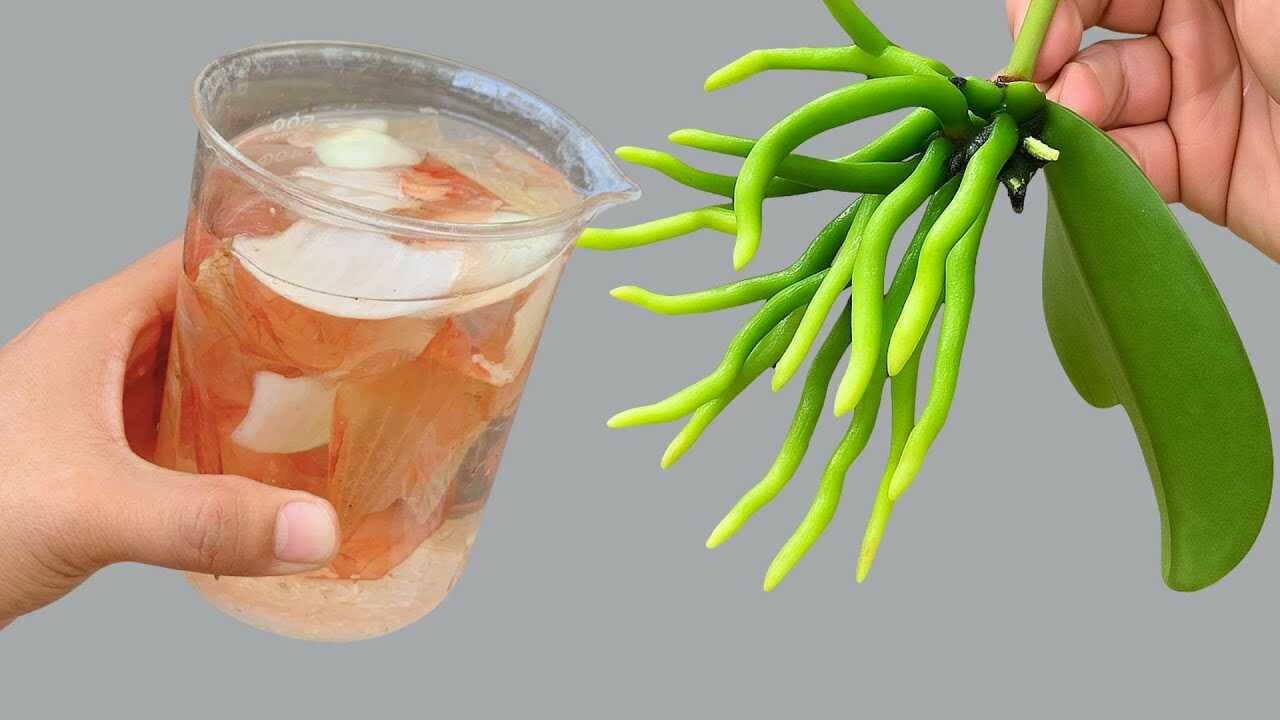
In the photo you can clearly see a beaker filled with translucent water and stacks of brown-orange, papery onion skins. On the right, an orchid with fresh green aerial roots waits. This article explains a practical, evidence-based way to use those onion skins as a gentle plant tonic for orchids — not a miracle cure, but a supplementary treatment that supports root health and resilience when combined with correct light, watering and potting medium.
Why onion skins? The botanical facts
Onion skins (outer dry layers of Allium cepa) are rich in polyphenols such as quercetin, sulfur-containing compounds and small amounts of soluble minerals (including potassium and trace elements). Quercetin and sulfur compounds have documented antioxidant and mild antimicrobial activity; these properties can help reduce microbe pressure around roots and provide trace nutrients that support metabolic processes. This makes a diluted onion-skin tea a sensible supplement to routine orchid care.
Important: a supplement, not a replacement
This method complements — it does not replace — proper orchid care: correct light, appropriate watering, good drainage and balanced fertilizer. Expect measurable changes only after several weeks of regular use, not overnight.
Step-by-step: how to prepare and use onion skin tea for orchids
- Collect: Save dry outer skins from 2 medium onions (about 30 g fresh-weight skins). Dried skins may be lighter; aim for roughly a handful ~30 g.
- Brew: Place skins in 1 liter of cold water. Bring to a gentle simmer for 8–10 minutes, then remove from heat and steep for 1 hour. Do not boil vigorously — gentle heat extracts polyphenols without concentrating salts excessively.
- Cool & strain: Allow to reach room temperature, then strain well. This is your concentrated onion-skin tea (stock).
- Dilute for use:
- Root drench (potted orchids): dilute stock 1:5 (1 part stock + 4 parts water). For a standard 4–6″ pot, apply 50–100 ml of the diluted solution so the medium is wetted but not waterlogged.
- Foliar / aerial root mist: dilute stock 1:10 and mist lightly to aerial roots and underside of leaves; avoid heavy soaking. Use early morning or late afternoon.
- Application frequency: During active growth (spring–summer) apply the root drench every 3–4 weeks. In autumn–winter reduce to once every 6–8 weeks. Use foliar mist at the same intervals, but never on the same day as a chemical fungicide or strong fertilizer.
- Flushing: Flush the potting medium with plain water once per month (run-through) to avoid mineral buildup.
Practical tips from experience
- Always test on a single plant first. Check for leaf or root sensitivity for 2–3 weeks before treating a larger collection.
- Use room-temperature tea. Cold-shock or hot liquid can stress orchid roots.
- For orchids in bark mix, use the lower drench volume and allow extra draining time; bark holds less water and concentrates solutions faster.
- Store unused stock in the refrigerator and use within 5–7 days; discard if it develops an off odor.
- If you grow orchids mounted on wood, use the 1:10 mist and avoid saturating the mount too often — frequency every 3–4 weeks is enough.
Common mistakes to avoid (real botanical pitfalls)
- Over-concentration: Applying undiluted or only slightly diluted onion tea can raise salt or sulfur levels and burn roots. Always follow the dilution ratios above.
- Too frequent use: Orchids are sensitive to buildup. More frequent applications do not speed results and can cause root stress. Stick to the schedule.
- Poor drainage: Using this tonic on waterlogged plants increases rot risk. Make sure the potting medium drains freely and roots get air between waterings.
- Using on damaged tissue: Do not apply strong sprays to open wounds or freshly cut roots; wait until tissue begins to heal.
- Expecting instant blooms: Healthier roots support better flowering, but visible improvement in roots and vigor usually appears over 4–8 weeks; flowering may follow in the next bloom cycle (several weeks to months).
When to skip onion-skin tea
Avoid this treatment if an orchid is already showing severe root rot with black mushy roots — treat rot directly (repot, remove dead tissue) before using supplements. Also skip if you or household members have strong onion/allium allergies that could be aggravated by airborne compounds.
Conclusion — try it and observe
Onion skins are a low-cost, evidence-backed source of polyphenols, sulfur compounds and trace minerals that can provide a mild antimicrobial and nutrient boost to orchid roots when used carefully. Prepare a gentle tea, follow the dilution and timing above, and treat this as a supportive practice — not a miracle fix. Expect to see healthier-looking roots and firmer growth in about 4–8 weeks; flower improvements may appear in the next bloom cycle.
Start with one plant, document changes, and if you see clear benefits, add this as a seasonal supplement to your orchid care routine. Enjoy the process and happy growing!