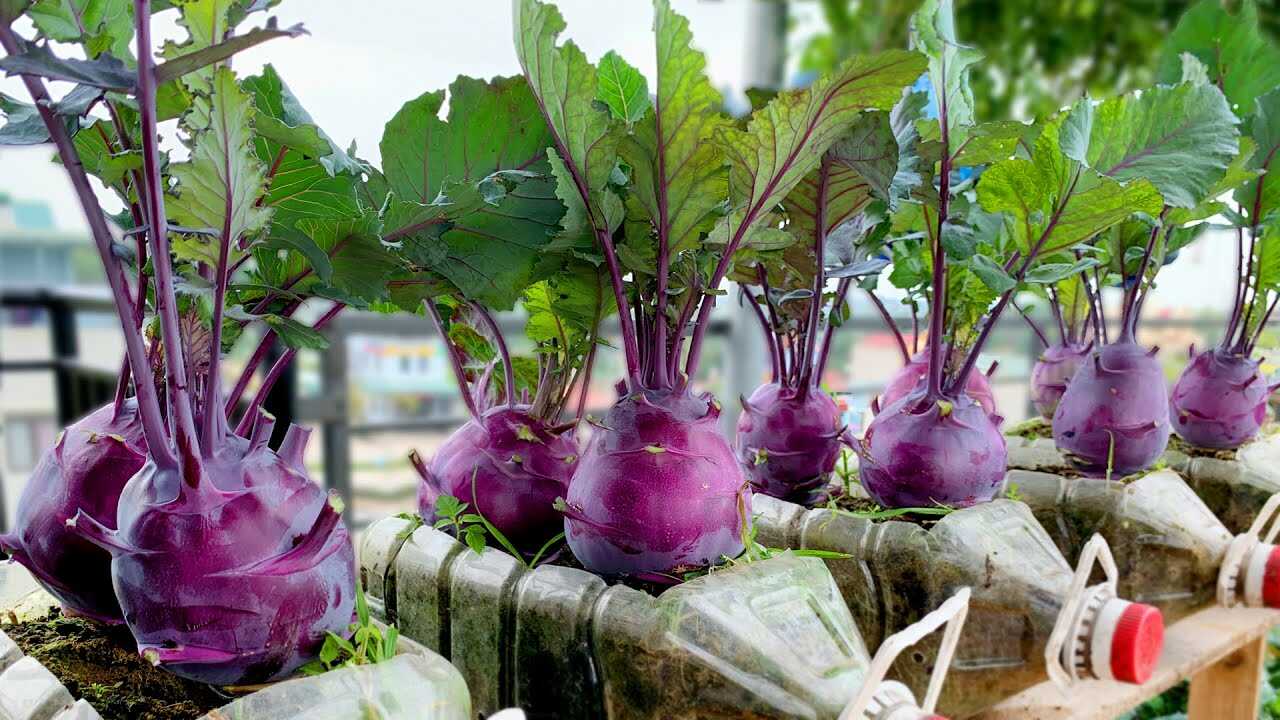
Growing Purple Kohlrabi on the Terrace is big and beautiful, very easy for beginners
Growing Purple Kohlrabi on the Terrace is big and beautiful, very easy for beginners
The photo shows glossy, round **purple kohlrabi** bulbs grown in repurposed plastic bottles on a sunny terrace. Those deep-magenta bulbs are not just striking — their color comes from **anthocyanin** pigments (real plant flavonoids) that respond to light and cool temperatures. This guide shows exactly how to reproduce that big, beautiful look in containers, step by step, with precise doses and realistic timelines.
Why grow purple kohlrabi on a terrace?
Purple kohlrabi (a Brassica) is compact, fast-growing and perfect for **container gardening**. The purple skin contains **anthocyanins**, antioxidant pigments whose production increases with bright light and cooler nights — which helps deepen the color you see in the image. Kohlrabi forms a swollen stem above the soil, not a deep root, so it fares very well in shallow to medium containers on balconies and terraces.
What you’ll need
- Container: 5–10 L (1.3–2.6 gal) pot or repurposed plastic bottle with drainage holes (one plant per container).
- Potting mix: 70% quality loam-based potting mix + 30% mature compost.
- Slow-release granular fertilizer: balanced NPK (e.g., 10-10-10).
- Liquid fertilizer: water-soluble balanced fertilizer for feeding (use at half strength as directed below).
- Seeds or seedlings: purple kohlrabi variety (transplant seedlings are easiest for beginners).
- Optional: floating row cover for early pest control.
Step-by-step planting and care
- 1. Prepare the container. Ensure at least 20–25 cm (8–10 in) of soil depth. Drill or poke multiple drainage holes in the bottom of the plastic bottle or pot.
- 2. Mix soil and fertilizer. For a 5–7 L container, mix 1 part compost into 3 parts potting mix and add 2 tablespoons (approx. 20 g) of balanced granular fertilizer (10-10-10) into the soil mass before filling the container. This provides starter nutrients for the bulb and leaves.
- 3. Planting. Transplant a seedling so the stem root collar sits just above the soil. One plant per container. Space several containers with at least 15–20 cm between plants for airflow.
- 4. Watering dose and frequency. For a 5–7 L container, water roughly 0.5–1.0 L per plant each watering. In warm season (temperatures consistently above 20°C / 68°F), water every 24–48 hours or whenever the top 2 cm of soil is dry. In cool season, water every 3–5 days. Keep soil consistently moist but not waterlogged.
- 5. Liquid feeding. From two weeks after transplant, feed with a water-soluble balanced fertilizer at half strength every 10–14 days during active growth. This maintains steady nutrient supply for bulb swelling.
- 6. Light and temperature. Place containers in full sun (at least 5–6 hours daily). Cooler nights (10–15°C / 50–59°F) enhance **anthocyanin** production and deepen purple color. If summer heat is extreme, provide light afternoon shade to avoid bolting.
- 7. Harvest timing. Expect harvest in 6–10 weeks after transplanting depending on variety and temperature. Harvest when bulbs reach 5–10 cm (2–4 in) across for best texture and flavor. Leave larger ones only for immediate use — very large bulbs can become woody.
Seasonal schedule at a glance
- Spring crop: Start seeds indoors 6–8 weeks before last frost; transplant outdoors after frost risk. Harvest 6–10 weeks after transplant.
- Fall crop: Sow/transplant so bulbs mature in cooler weather; cool nights intensify purple color. Harvest in 6–10 weeks.
Practical tips from experience
- One plant, one pot: Kohlrabi bulbs need their own space — overcrowding reduces bulb size and increases disease pressure.
- Consistent moisture: Irregular watering causes fibrous or split bulbs. Use saucers or self-watering inserts on windy terraces to reduce evaporation.
- Enhance purple color: Maintain full sun and aim for cooler nights in the weeks before harvest; this naturally increases **anthocyanin** accumulation.
- Mulch surface: A thin mulch (2–3 cm) of compost or straw keeps surface moisture and stabilizes temperature in containers.
- Pest control: Use floating row covers until plants are 10–12 cm tall to prevent flea beetles. For caterpillars, Bacillus thuringiensis (Bt) applied per label is effective and safe for edible crops.
Common mistakes to avoid
- Planting too shallow or in tiny containers: Containers under 4 L will restrict bulb development.
- Over-fertilizing nitrogen late: Too much nitrogen after bulbs begin forming promotes leafy growth at the expense of swollen stems.
- Ignoring drainage: Poor drainage leads to root and crown rot; always ensure multiple exit holes and avoid standing water.
- Waiting too long to harvest: Leaving bulbs to oversized size for weeks causes woody, pithy texture. Harvest within the 6–10 week window for best taste.
- Skipping crop rotation: Repeated Brassica planting in the same potting compost increases clubroot and soil-borne disease risk; refresh potting mix yearly or rotate container locations.
Why this method works (botanical facts)
Kohlrabi is a Brassica that stores carbohydrates in the swollen stem and synthesizes **anthocyanins** in the skin when exposed to light and cooler temperatures. Balanced early nitrogen supports leaf growth and photosynthesis, while regular feeding and consistent moisture support the transfer of sugars into the bulb. These are established botanical principles, so the visual richness and size you see in the photo are achievable with proper light, soil volume, nutrient management and timing.
Conclusion — get started this weekend
Replicating the gorgeous, large **purple kohlrabi** on your terrace is straightforward: use a 5–10 L container, ensure 20–25 cm soil depth, add 2 tablespoons of balanced granular fertilizer per pot at planting, water 0.5–1.0 L per plant as needed (summer every 24–48 hrs; cool season every 3–5 days), and feed half-strength liquid fertilizer every 10–14 days. Expect a harvest in 6–10 weeks. Start with a few bottles or pots, note how light and nights affect color, and enjoy fresh, crunchy kohlrabi straight from your terrace. Try it now, and share a photo of your first harvest — I’d love to hear how your purple bulbs turn out!