If the tree does not bloom, do this right away the tree will flower non stop
If the tree does not bloom, do this right away the tree will flower non stop
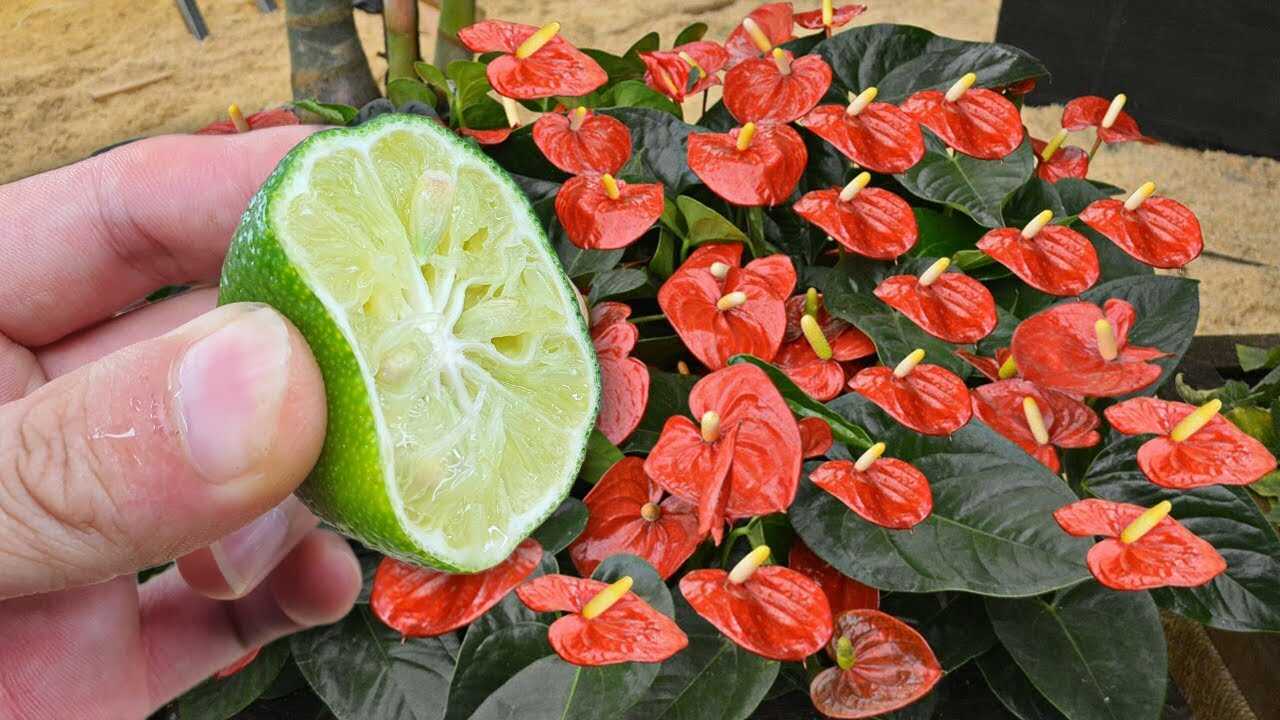
In the photo you can clearly see a halved **fresh lime** being held over bright red flowers — that **fresh lime juice** (visible as the pale, wet pulp and juice) is the ingredient this article focuses on. Used carefully as a dilute root drench, **fresh lime juice** (citric acid) can help correct localized alkaline conditions and improve **iron and micronutrient availability**, which can encourage better bud development and more reliable flowering. This is a supplementary tip — not a miracle — and must be combined with good light, watering, drainage and balanced fertilization.
Why fresh lime juice can help flowers (botanical reason)
Lime juice contains **citric acid**, a weak organic acid that can temporarily lower the pH in the rhizosphere and act as a natural chelator for iron and some micronutrients. In alkaline soils iron becomes insoluble and unavailable to roots, causing poor leaf health and weak bud set. A correctly diluted lime-juice drench can increase iron availability and improve nutrient uptake, helping a stressed, non-flowering tree begin to set buds. This is a short-term correction — persistent pH problems are best solved by soil amendments and testing.
Step-by-step: prepare and apply the lime-juice treatment
- Materials: fresh limes (not bottled juice), clean container, measuring spoon, clean water, soil pH test kit.
- Make the solution: Squeeze fresh lime juice and dilute to a concentration of 15 ml (1 tablespoon) of fresh lime juice per 1 L (quart) of water. Mix thoroughly. Strain out large pulp or seeds if needed.
- Spot test first: If you haven’t measured soil pH, test the soil at the root zone. If soil pH is already below 6.0, do not apply — the risk of over-acidifying is real.
- Application volumes: For a potted or small ornamental tree (up to ~20 L pot), apply 1–2 L of the diluted solution evenly over the root zone. For a small garden tree (young ornamental tree planted in the ground), apply 5–10 L of solution around the dripline, pouring slowly so it soaks in. For large trees consult a professional; do not overapply.
- Timing & frequency: Apply during the active growth period when buds form — typically spring to early summer. Use the treatment every 3–4 weeks, for a maximum of 3 applications in one season. Expect to see improved bud set or reduced chlorosis within 4–8 weeks if the issue was pH-related.
- Follow-up: Re-test soil pH 4 weeks after the final application. If pH has dropped below 5.5–6.0, stop treatments and consider lime or other amendments to rebound to safe range.
Practical tips from experience
- Always use fresh lime juice — bottled citrus can contain preservatives or added acids that change concentration and can harm roots.
- Do not spray undiluted lime juice on foliage — the acid and citrus oils can cause leaf burn. This protocol is a soil drench only.
- Water deeply after a drench only if soil is dry — the goal is to move the dilute acid into the root zone without creating waterlogged conditions.
- Combine this approach with a bloom-oriented fertilizer that supplies phosphorus and potassium; citric acid helps micronutrient uptake but does not replace N-P-K needs.
- If you suspect iron deficiency (yellowing between leaf veins), this treatment can help as part of a broader plan that includes mulching, organic matter and proper irrigation.
Common mistakes to avoid
- Do not use high concentrations. >15 ml/L or repeated weekly drenching risks root damage, microbial disruption and excessive acidification.
- Avoid applying during extreme heat or drought — stressed roots absorb poorly and are more sensitive to chemical changes.
- Don’t expect instant flowering. Improvements from correcting micronutrient availability will appear over several weeks, not days.
- Never use citrus oils, cleaners, or concentrated citrus extracts — these are phytotoxic and not equivalent to fresh juice.
- Do not ignore the cause: if poor bloom is due to insufficient light, wrong pruning, root congestion, or lack of phosphorus, citric acid alone won’t fix it.
Conclusion — try it, test, and observe
If your tree is failing to bloom and you see signs of alkaline stress or iron chlorosis, try a cautious, measured application of **fresh lime juice diluted to 15 ml per liter**, applied as a soil drench every **3–4 weeks** for up to **3 treatments** during the bud-setting season. Always pair this with proper light, watering, drainage and balanced fertilization, and monitor soil pH before and after. Give it **4–8 weeks** to show benefit — and if you’re unsure, perform a soil test or consult a local extension service. Try the treatment on one specimen first, observe results, and share what you see — your tree may just reward you with steadier, healthier blooms.