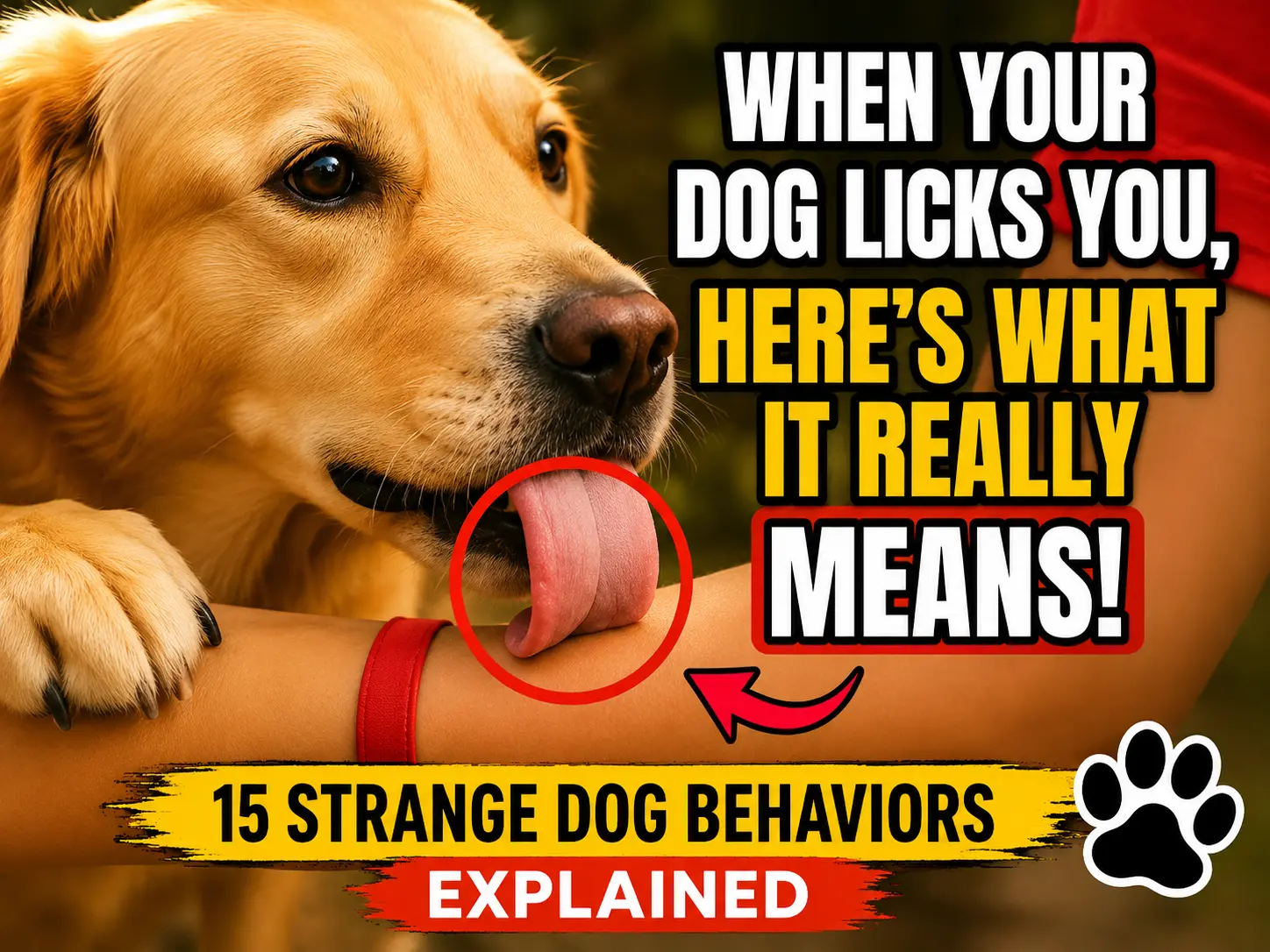
When Your Dog Licks You, HERE’S What It Really Means! 15 Strange Dog Behaviors Explained
If you share your home with a dog, you’ve probably found yourself asking the same question at least once:
“Why on earth is my dog doing that?”
Maybe they bark at an empty room. Maybe they sit stubbornly in the rain. Maybe they scratch the ground like they’re preparing for a construction project in your backyard.
And then there’s the licking.
A quick lick on the hand can feel sweet. A full face wash at 7 a.m. is a different story entirely.
The funny thing is that most dog habits aren’t random at all. Behind many of the behaviors that make us laugh, worry, or scratch our heads, there’s usually a mix of instinct, communication, emotion, and thousands of years of canine history.
After years of living with dogs and talking with trainers, veterinarians, and fellow pet lovers, I’ve learned that dogs are often telling us much more than we realize.
Let’s decode some of the strangest things they do.
Quick Answer
When your dog licks you, it’s usually a sign of affection, trust, communication, or a request for attention. Dogs learn licking as puppies and often continue the behavior with the humans they consider family. In many cases, a lick simply means: “You’re my person.”
Table of Contents
- Why Dogs Bark When Visitors Arrive
- Why Dogs Bark at “Nothing”
- The Truth About Selective Hearing
- Why Dogs Sniff Everything
- Sitting in the Rain
- Fear of the Vacuum Cleaner
- The Doorway Dilemma
- Why Dogs Eat Grass
- Digging and Destroying
- Post-Potty Zoomies
- Morning Stretching Rituals
- Twitching During Sleep
- Howling at Sirens
- Caring for Their Humans
- What Dog Licking Really Means
- FAQ
- About Sophia
Why Dogs Bark When Visitors Arrive
A barking dog at the front door isn’t necessarily a badly behaved dog.
Often, it’s simply an ancient protective instinct at work.
Your dog notices a new person before you fully process who’s standing outside. The bark is their way of announcing:
“Someone’s here.”
Sometimes it’s protection.
Sometimes it’s excitement.
And sometimes it’s both at the same time.
I’ve noticed many dogs calm down quickly once they’ve had a chance to greet the visitor and assess the situation.
Practical Tip
Teach a “bark once, then settle” routine instead of trying to eliminate barking entirely.
Why Dogs Bark at “Nothing”
To us, the room seems quiet.
To a dog, it’s full of information.
Dogs hear frequencies we can’t hear. They detect footsteps, distant sounds, wildlife movement, and scents that never register on our radar.
What looks like barking at nothing may actually be a response to something we simply cannot detect.
Sophia’s Observation
One of my dogs used to bark toward the back fence at night. Weeks later, we discovered raccoons had been passing through the yard regularly.
The dog knew long before we did.
The Truth About Selective Hearing
Your dog hears the refrigerator open from three rooms away.
Yet somehow “Come here” becomes optional.
This isn’t always stubbornness.
Dogs are experts at association.
If a command consistently ends the fun, they may become less enthusiastic about responding.
They’re also remarkably good at reading our mood and confidence.
Practical Tip
Make recalls rewarding. Praise, treats, and positive experiences help create stronger responses over time.
Why Dogs Sniff Everything
A patch of grass isn’t just grass.
It’s an information board.
Dogs can gather details about other animals, health status, gender, territory, and even emotional states through scent.
That long pause during a walk isn’t laziness.
It’s research.
Practical Tip
Allow extra sniffing time during walks. Mental stimulation can be just as valuable as physical exercise.
Sitting in the Rain
Some dogs freeze the moment rain begins.
Rain changes scents, sounds, textures, and visibility.
For many dogs, the world suddenly feels different.
Others simply dislike getting wet.
Honestly, I can’t blame them.
Sophia’s Observation
Small indoor dogs seem especially likely to pause and reconsider their life choices during the first drizzle.
Fear of the Vacuum Cleaner
To humans, it’s an appliance.
To dogs, it’s a loud moving creature that appears unexpectedly and growls.
Vacuums combine noise, vibration, motion, and unpredictability.
That’s a lot for a dog to process.
Practical Tip
Introduce the vacuum gradually and reward calm behavior rather than forcing interactions.
The Doorway Dilemma
Out.
In.
Out again.
Back inside.
Many dogs aren’t confused.
They’re simply following competing impulses.
Curiosity, territory checks, boredom, and changing interests all play a role.
Sometimes they just want to know the option exists.
Why Dogs Eat Grass
Grass eating is surprisingly common.
Some dogs may do it to soothe mild stomach discomfort.
Others simply enjoy the texture and taste.
Spring grass seems especially popular.
Occasional grass eating is generally normal.
If it becomes excessive or is paired with frequent vomiting, a veterinarian should be consulted.
Digging, Scratching, and Zoomies
Digging
Some breeds were literally bred to dig.
Others do it to relieve stress, burn energy, or create a comfortable resting spot.
Post-Potty Zoomies
The sudden sprint after bathroom time is completely normal.
Many owners affectionately call these “zoomies.”
It’s a burst of energy and relief all rolled into one hilarious moment.
Morning Stretching and Dreaming
That big front-leg stretch after waking up is more than a muscle warmup.
It’s also a friendly social signal.
Many dogs stretch when greeting someone they love.
And if your dog twitches during sleep?
They’re probably dreaming.
Just like us, dogs enter active dream phases where the brain remains busy while the body rests.
Howling and Caring for Their Humans
Why Dogs Howl
Sirens often trigger howling because they resemble long-distance canine communication.
Your dog may be responding with:
“I’m here too.”
Why Dogs Comfort Us
Dogs notice emotional changes remarkably well.
When you’re sad, sick, stressed, or crying, many dogs instinctively move closer.
A nudge.
A cuddle.
A quiet presence.
It’s their version of support.
What Dog Licking Really Means
Now let’s return to the question that brought you here.
Why does your dog lick you?
The answer is surprisingly emotional.
Licking begins early in puppyhood as a way to communicate with their mother.
As adults, many dogs transfer this behavior to the humans they trust most.
A lick can mean:
- I love you.
- I trust you.
- I want attention.
- I feel safe with you.
- I want to comfort you.
Dogs may also pick up subtle chemical changes linked to stress or emotion.
In a strange way, licking can be part affection and part information gathering.
Sophia’s Observation
One of the sweetest moments I’ve ever witnessed was a dog gently licking its owner’s hand while she cried after a difficult day.
No commands.
No training.
Just instinctive comfort.
Sometimes dogs understand more than we give them credit for.
FAQ
Is it normal for dogs to lick their owners?
Yes. In most cases, licking is a normal expression of affection, communication, or attention-seeking behavior.
Why does my dog bark at an empty room?
Your dog may be reacting to sounds, scents, reflections, or movements that humans cannot easily detect.
Should I stop my dog from eating grass?
Occasional grass eating is generally normal. Excessive grass eating combined with illness should be discussed with a veterinarian.
Why does my dog follow me everywhere?
Dogs are social animals and often stay close to people they trust and consider part of their family group.
Are zoomies a sign of happiness?
Usually, yes. Zoomies are often linked to excitement, relief, and bursts of energy.