Just one carrot! And the orchid blooms continuously all year round!
Just one carrot! And the orchid blooms continuously all year round!
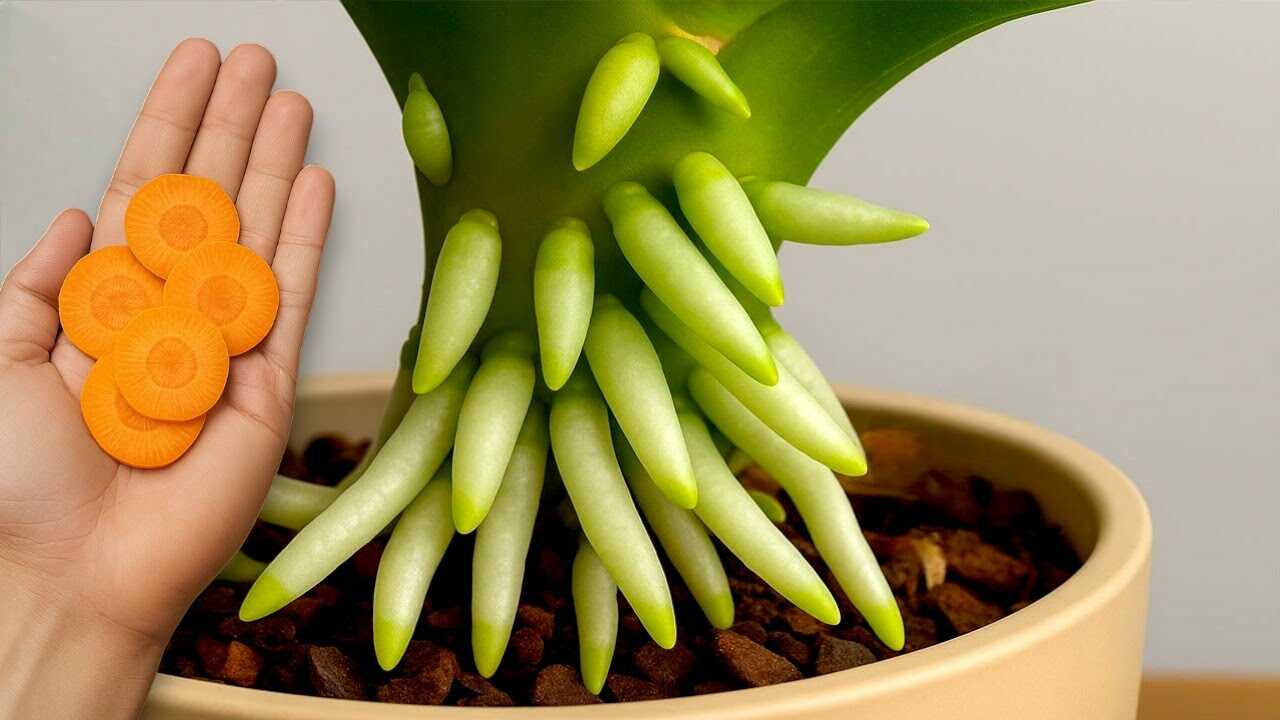
In the photo you can see a small pile of bright **carrot slices** in a hand beside an orchid with thick green aerial roots sitting in a bark potting mix. This article explains a safe, factual way to use those **carrot slices** as a tiny organic nutrient boost to support healthier **orchid roots** and more reliable flowering over the growing season — always as a complement to proper light, watering, potting mix and fertilization.
Why a carrot slice can help (real botanical reasons)
Carrots are rich in **potassium**, small amounts of **phosphorus** and soluble sugars. When a thin carrot slice decomposes in potting media it releases these soluble minerals and feeds soil microbes. Increased microbial activity can improve mineral cycling around the orchid’s roots and make some nutrients more available over time. This is a slow, subtle effect — not a miracle — and it supports plant health which in turn helps **flowering**.
Step-by-step: how to use a carrot slice safely with orchids
- Choose and wash: use a fresh carrot (organic preferred). Rinse well to remove soil, wax or pesticide residues.
- Slice thin: cut one thin round (about 2–3 mm thick, ~3–5 g) for a standard 12 cm / 5″ orchid pot. Thin slices decompose faster and attract fewer pests than large chunks.
- Dry briefly (optional): air-dry the slice for 12–24 hours on a paper towel to reduce surface moisture that can attract flies.
- Place, don’t touch the crown: tuck the slice 2–3 cm from the pot edge and 1–2 cm below the bark surface. Keep it at least 3–4 cm away from the orchid’s crown and major roots to avoid direct rot contact.
- Cover lightly: return a small layer of bark so the slice is buried but still in contact with the potting media (not exposed on the surface).
- Monitor: check weekly for pests or unpleasant rot smell. Remove immediately if maggots, gnats or heavy mold appear.
Dose and frequency (exact and seasonal)
For a 12 cm (5″) pot: use one thin slice (≈3–5 g) every 6–8 weeks during the active growth months (spring and summer). In autumn reduce to one slice every 12 weeks. Do not add during cold dormancy if your orchid slows growth in winter. For larger pots, use one slice per each 10 cm (4″) of pot diameter.
Alternative: carrot “tea” for a gentler feed
If you prefer not to bury organic matter in an epiphytic bark mix, make a diluted carrot infusion: simmer five thin slices in 500 ml of water for 10 minutes, cool, strain and dilute the liquid 1:5 with water. Use 100–150 ml per 12 cm pot as a light soil drench every 4–6 weeks during spring and summer. This gives soluble potassium and sugars without introducing large pieces that attract pests.
Practical tips from experience
- Use sparingly. Orchids are sensitive to overfeeding; a little goes a long way. The goal is a slow-release micro-boost, not a replacement for balanced orchid fertilizer.
- Combine with good care. This tip complements correct light (bright, indirect), consistent watering with good drainage, and occasional balanced orchid fertilizer (diluted). Without those basics, carrot slices won’t make a struggling plant bloom.
- Watch water and ventilation. Keep the potting mix airy (bark, perlite) and allow the top to dry slightly between waterings to avoid prolonged sogginess that encourages rot.
- Hygiene matters. Remove uneaten carrot pieces after 6–8 weeks if they remain intact. Replace with a fresh thin slice only on schedule.
Common mistakes to avoid (real botanical pitfalls)
- Burying against the crown or major roots. This can cause local rot and crown infection; always place slices at the pot edge.
- Using large chunks. Big pieces stay wet longer, attract pests and create anaerobic pockets — use thin slices only.
- Overdoing it. Multiple slices per pot or too-frequent application can create excessive microbial activity and salt build-up; follow the dosing above.
- Ignoring pests. If fungus gnats or maggots appear, stop using organic slices and treat the pest problem before resuming any organic amendment.
How long until you see an effect?
Expect subtle changes in root vigor and nutrient availability over several weeks to a few months. Improvements in blooming frequency can appear within 6–12 weeks of regular spring/summer applications if all other care factors are correct. This is a supportive practice, not an instant bloom trigger.
Final reassurance and call to action
Using a single clean, thin carrot slice as described is a small, factual way to add organic minerals and microbial food to your orchid’s potting media. It can help healthier roots and more reliable flowering when used sensibly alongside proper light, watering, drainage and fertilization. Try it once this growing season, watch your plant for 6–12 weeks, and let the results guide whether to continue. If you have questions about your orchid’s species or current potting mix, share a photo and I’ll help you adapt the method safely.