Just pour 1 spoon! Immediately 100 roots will appear and bloom all year round
Just pour 1 spoon! Immediately 100 roots will appear and bloom all year round
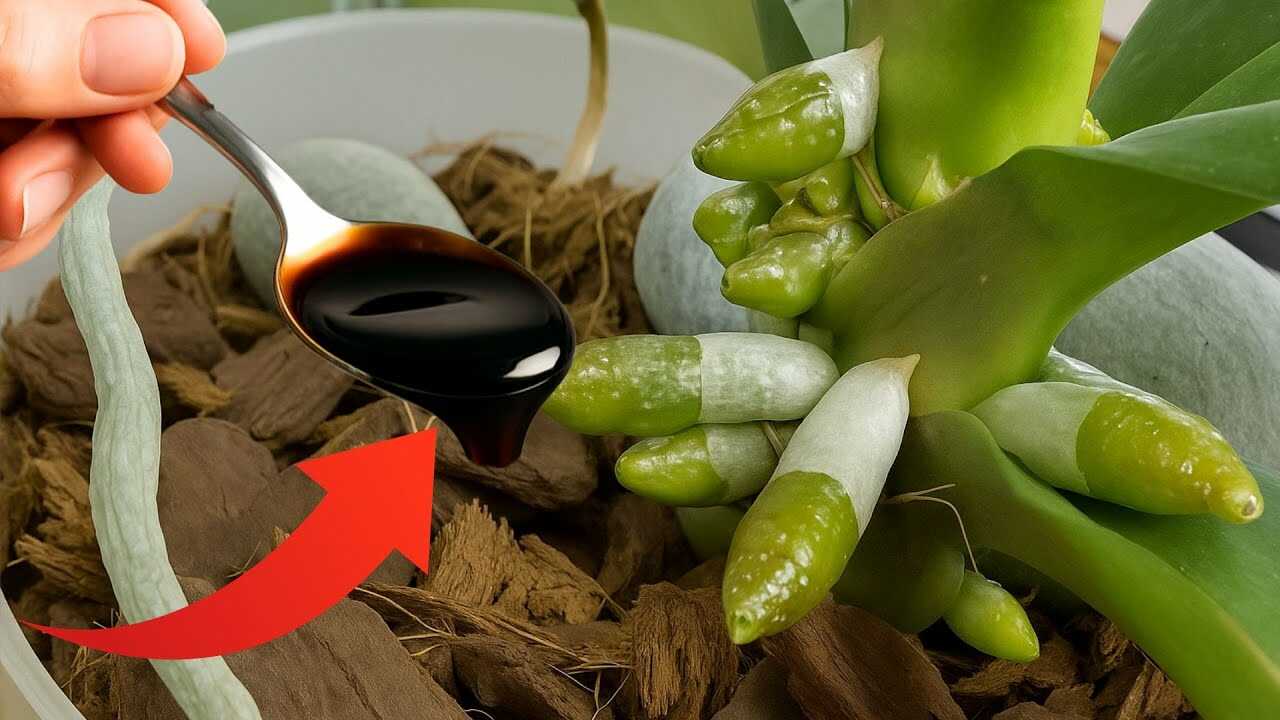
In the photo you can clearly see a spoon holding a thick, dark syrup being poured near an orchid in a bark mix. That liquid is best interpreted as unsulphured blackstrap molasses — a viscous, brown‑black syrup used by gardeners to feed microorganisms and add trace minerals. This article explains exactly how to use that molasses safely as a supplement to encourage healthier roots and better nutrient availability in potted orchids and other container plants.
Why molasses? The real botanical basis
Blackstrap molasses contains simple sugars and small amounts of minerals (potassium, calcium, magnesium, iron) and organic carbon. In horticulture it’s used primarily as a microbial food source. When diluted and applied to the substrate, molasses feeds beneficial heterotrophic bacteria and fungi that can accelerate mineralization of organic matter, improving micronutrient availability to roots. This is a biological effect — not a direct hormone or instant rooting chemical — and it supports root health over several weeks.
Step‑by‑step: How to prepare and apply (precise doses)
- Choose the right product: Use unsulphured blackstrap molasses sold for food or agricultural use. Avoid sulphured molasses or products with additives and salt.
- Prepare the solution: Measure 1 teaspoon (5 mL) of molasses and dissolve it in 1 liter (≈1 quart) of warm water. Warm water helps the molasses dissolve evenly.
- How to apply: Water the plant first with plain water so the substrate is moist. Then apply the molasses solution as a gentle drench around the root zone (pour along the edge of the pot, avoiding the crown and leaves). Use only enough to moisten the substrate; do not saturate until runoff every time.
- Frequency (seasonal): During active growth (spring–summer) apply the molasses solution every 3 weeks. Expect to continue this routine for at least 6–12 weeks before expecting noticeable increases in root activity. In fall–winter, reduce to once every 6–8 weeks or suspend if the plant is in dormancy.
- Optional for compost/tea: If you brew a compost tea to inoculate the substrate, you can add 1 tablespoon (15 mL) of molasses per 4 liters (1 gallon) to the brew to feed microbes during aerated brewing. Apply tea to substrate per the same seasonal schedule.
Practical tips from experience
- Apply to substrate, not crown: For orchids, never pour molasses directly on the crown or on aerial roots — sugars sitting on leaf bases encourage rot and fungal infections.
- Measure carefully: Keep to the 1 tsp per liter dilution. Higher concentrations rapidly increase fungal growth and can harm roots.
- Combine with good basics: Use molasses as a supplement alongside proper light, watering, drainage and a balanced orchid fertilizer (follow manufacturer directions). Molasses does not replace N‑P‑K or correct watering practice.
- Watch for pests: Sugar in the substrate can attract fungus gnats and other pests. If you notice gnats, reduce molasses frequency, let the substrate dry more between waterings, and use sticky traps or biological controls (e.g., Bacillus thuringiensis israelensis) as needed.
- Flush periodically: Every 3–6 months rinse the potting medium with plain water to prevent salt or residue build‑up.
Common mistakes to avoid (real botanical consequences)
- Overconcentrating the solution (too much molasses) — causes rapid fungal growth, depleted oxygen in the root zone and root loss.
- Applying during dormancy — plants not actively growing won’t benefit and are more prone to rot.
- Pouring on the crown or leaves — leads to crown rot, leaf spotting or fungal infections.
- Relying on molasses as a fertilizer substitute — molasses does not supply enough N‑P‑K for sustained growth; it only supports microbial activity and micronutrient availability.
- Using sulphured or impure syrups — sulphur preservatives or added salts can damage roots and microbes.
How long until you see results?
Be realistic: improvements from feeding microbes with molasses appear over time. You may notice increased microbial smell and substrate activity within a couple of weeks, but meaningful root thickening and new root emergence typically require 6–12 weeks of correct, repeated applications in combination with proper cultural care.
Final encouragement and call to action
If you’re inspired by the image and want to try the “one spoon” approach, use 1 teaspoon (5 mL) of unsulphured blackstrap molasses per 1 liter of water and follow the seasonal schedule above. Track changes with photos of roots every 2–4 weeks and pair this treatment with correct light, watering, and a suitable fertilizer. When used carefully, molasses is a low‑cost, low‑risk microbial booster — a smart supplement, not a miracle cure.