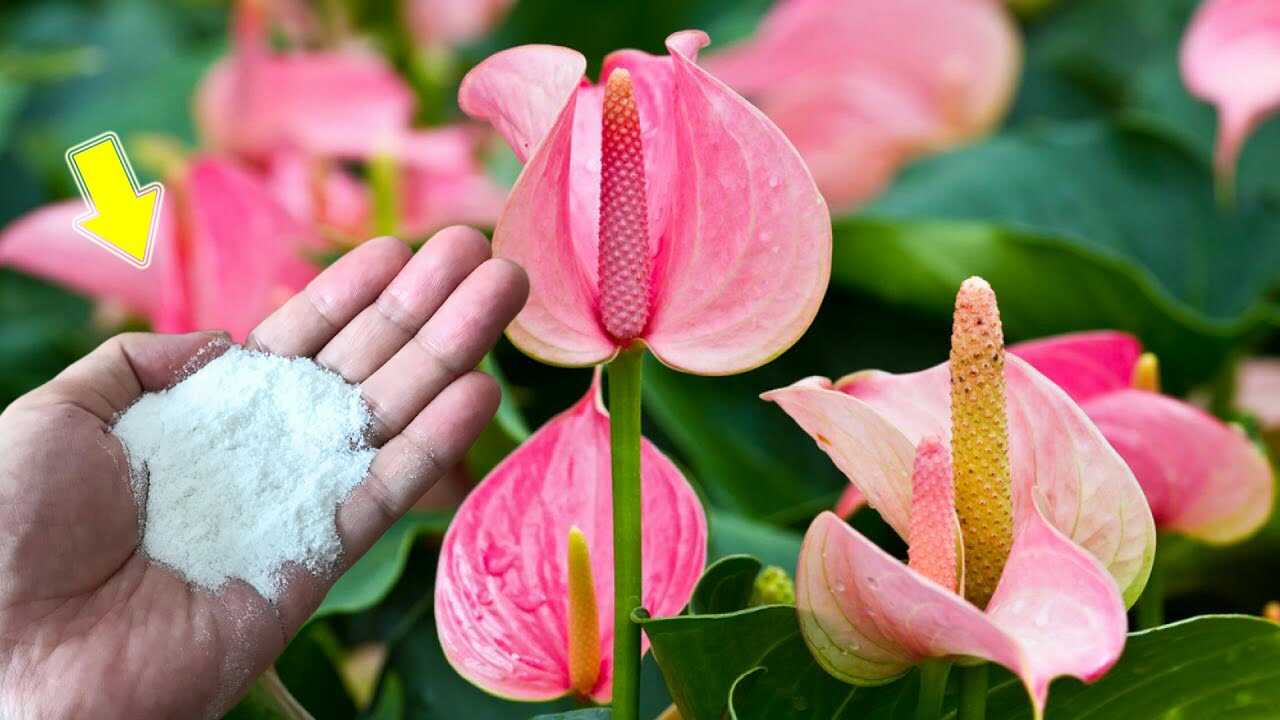
Sprinkle A Little On The Roots! Even The Weakest Anthurium Plant Blooms Immediately!
Sprinkle A Little On The Roots! Even The Weakest Anthurium Plant Blooms Immediately!
The photo shows a hand holding a fine white crystalline powder that looks like **Epsom salt (magnesium sulfate)** — the same common white granules many gardeners use around houseplants. In this article I’ll show you a safe, evidence-based way to use **Epsom salt** as a targeted supplement for anthuriums, why it can help flowering, and exactly how to prepare and dose it so you see real improvement over several weeks.
Why Epsom Salt Helps Anthuriums
Magnesium (the Mg in magnesium sulfate) is an essential plant nutrient that plays a central role in **chlorophyll production**, enzyme activation and nutrient uptake. Anthuriums that are pale, produce few spathes, or have slow vigor can sometimes respond when a magnesium deficiency is corrected. The sulfate (SO4) provides sulfur, another plant nutrient. Used correctly, Epsom salt is a targeted supplement — not a substitute for good light, watering, drainage or a balanced fertilizer.
When This Trick Can Help
- Symptoms to watch for: older leaves yellowing between veins (interveinal chlorosis) while veins remain greener, slow growth, or fewer blooms than expected.
- When to apply: during the active growing season — spring through early autumn. Avoid routine use in winter when growth slows.
- Realistic timeline: expect leaf color and flowering responses to develop over 4–8 weeks after a correct application, not instantly.
What You’ll Need
- Food-grade **Epsom salt (magnesium sulfate)** — white crystalline granules like in the image
- Measuring spoons and a clean container
- Water at room temperature
- A cup or small watering can for the drench
Step-by-step: Safe Root Drench for Anthurium
- Step 1 — Prepare the solution: Dissolve 1 teaspoon (≈5 g) of Epsom salt in 1 liter (≈1 quart) of water. Stir until completely dissolved. This is a mild, safe concentration suitable for potted anthuriums.
- Step 2 — Pre-water if very dry: If the potting mix is bone dry, water lightly first so the soil is slightly moist — this reduces risk of localized salt concentration.
- Step 3 — Apply at the root zone: Pour about 200–300 ml (≈1 cup) of the prepared solution around the base of a small to medium potted anthurium (adjust volume for larger pots). Allow it to drain through the pot’s drainage holes.
- Step 4 — Frequency: Repeat once every 3–4 weeks during spring and summer. For larger plants or multiple pots, use 1 tablespoon (≈15 g) per 4 liters (1 gallon) of water applied as a drench monthly. Stop or reduce to once every 8–12 weeks in autumn; avoid regular winter applications.
- Step 5 — Observe and adjust: Monitor leaves and blooms over the next 4–8 weeks. If you see improved greening and more frequent spathe production, continue the monthly regimen during the growing season. If no change or if leaves brown/edge scorch develops, stop and check for other issues.
Optional: Foliar Boost
If you prefer foliar feeding, dissolve 1 tablespoon of Epsom salt in 1 gallon (≈4 liters) of water and spray lightly on the leaves once a month in the morning. Do a small test spray first and avoid spraying in direct midday sun to prevent leaf scorch.
Practical Tips from Experience
- Test first: Try the soil drench on one plant or a small area before treating an entire collection.
- Balanced nutrition: Epsom salt supplies magnesium and sulfur only — it doesn’t replace a balanced fertilizer that supplies nitrogen, phosphorus and potassium (N-P-K). Use Epsom salt as a supplement to a regular houseplant fertilizer regime.
- Check light & humidity: Anthuriums need bright, indirect light and high humidity for best flowering. Epsom salt won’t fix poor light or stagnant humidity.
- Keep records: Note the date and amount applied so you can correlate progress over weeks.
Common Errors to Avoid
- Don’t sprinkle dry crystals on roots: Dry salts placed directly on soil can cause localized salt burn. Always dissolve before application.
- Don’t confuse with table salt: Sodium chloride (table salt) is harmful to plants. Make sure you use magnesium sulfate (Epsom salt).
- Avoid overuse: Excessive magnesium can unbalance other nutrients; following the stated doses prevents buildup and toxicity.
- Don’t expect magic: If the problem is poor drainage, root rot, insufficient phosphorus or pests, Epsom salt won’t solve it. Diagnose the real issue first.
When to Get a Soil Test or Expert Help
If symptoms persist after two monthly applications, or if you suspect root disease, check the potting mix, pH and nutrient levels. A simple soil test or plant clinic can show whether magnesium is actually low and whether phosphorus, potassium or pH adjustments are needed.
Conclusion — Try It, Then Evaluate Over Weeks
What you see in the image — white Epsom salt crystals — can be a useful, low-cost supplement to encourage healthier foliage and more consistent **Anthurium flowering** when used correctly. Follow the precise doses above, apply as a dissolved root drench once every 3–4 weeks in the growing season, and expect visible improvement over 4–8 weeks. This method complements good light, humidity, watering and a balanced fertilizer — it’s a helpful nudge for weak plants, not a miracle cure.
Give it one proper treatment cycle (4–8 weeks) and observe the change — your anthurium may reward you with greener leaves and more spathes when magnesium was the missing piece.