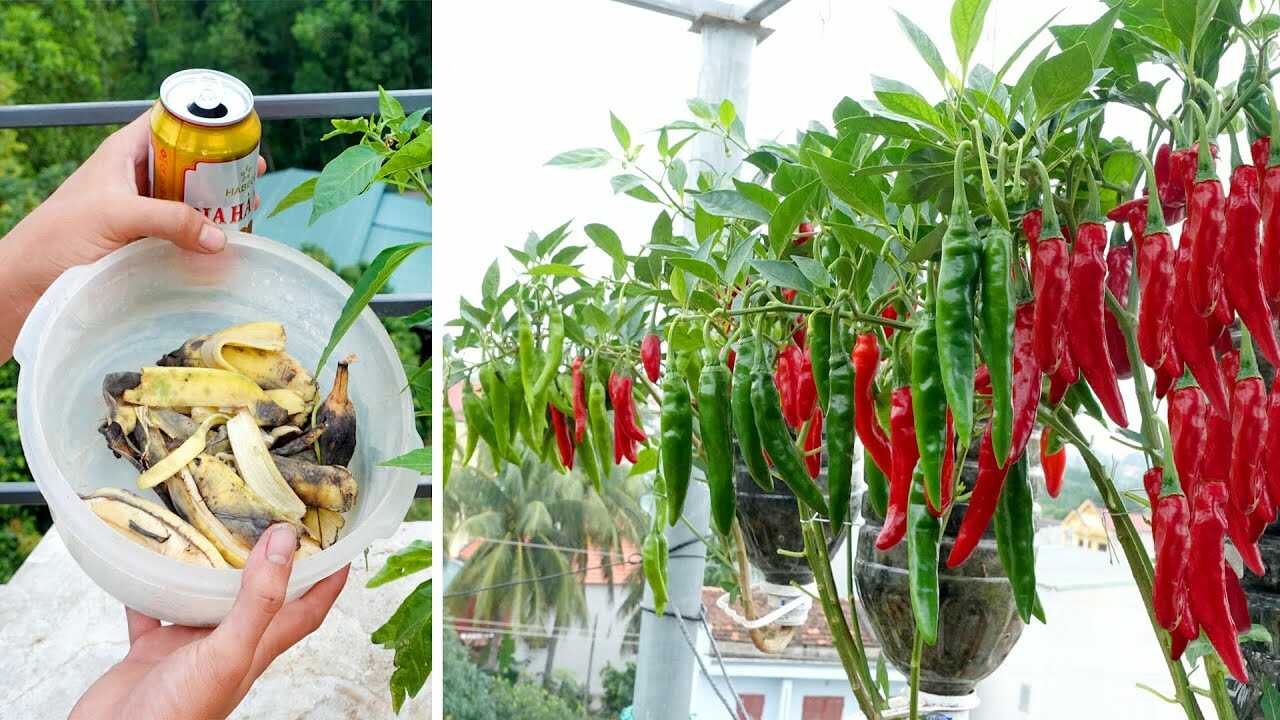
Tips for growing Chili in plastic bottles with many fruits and for year round harvest
Tips for growing Chili in plastic bottles with many fruits and for year round harvest
On the left of the image you can clearly see **banana peels** in a small container — yellow-brown skins with soft, fibrous texture. This article explains how to use those banana peels as a safe, measured supplement to boost flowering and fruiting of chilies grown in plastic bottle containers, and how to manage the system for a year‑round harvest.
Why banana peels help chilies (and what they actually provide)
Banana peels are a practical source of **potassium (K)** and small amounts of **phosphorus (P), calcium (Ca)** and **magnesium (Mg)**. Potassium is a well‑documented nutrient that supports **flower formation, fruit set and size** in fruiting plants like chili. Use banana peels as a supplement — not a replacement — for basic care (light, water, drainage and balanced fertilizer).
Materials and preparation — what you’ll need
- Plastic bottle container (1.5–5 L, cut and with drainage holes).
- Quality potting mix (loamy, well‑draining; mix 3:1 potting mix to perlite).
- Banana peels (fresh skins as shown in the photo).
- Optional: oven or sun for drying, blender or mortar to make powder; or a jar for steeping tea.
- Balanced fertilizer (liquid or granular N‑P‑K) for baseline nutrition.
Two safe ways to use banana peels — exact recipes and doses
1) Banana peel tea (fast, dilute foliar/soil feed)
Good when you want a quick potassium boost without adding bulky organic matter to small bottles.
- Place 1 medium banana peel (about 10–15 g fresh weight) in 1 litre of room‑temperature water.
- Steep for 48 hours in a closed jar (do not ferment more than 72 hr to avoid strong odors and anaerobic growth).
- Strain the liquid and dilute it 1:4 with water (one part steeped liquid to four parts water).
- Application dose: give each bottle plant 150–200 ml of the diluted tea around the root zone.
- Frequency: every 2 weeks during the active growing/fruiting season (spring–summer). Reduce to once every 4 weeks in cooler months if plants are kept indoors for year‑round harvest.
- Expect measurable improvement in flowering/fruit set within 4–8 weeks when combined with proper light, pruning and base fertilizer.
2) Dried banana peel powder (slow release in soil)
Best for long‑term potassium release inside small containers without attracting pests.
- Chop peels and dry them until brittle: sun dry for 24–48 hours or oven‑dry at 60–70°C until fully dry.
- Grind to a powder (blender or mortar). One medium banana yields ~7–12 g dry powder.
- Mix into potting mix at these rates: for a 1–2 L bottle pot, mix 1 tablespoon (≈7 g) of powder into the top 5–8 cm of soil; or incorporate 5% by volume when repotting.
- Top‑dress option: sprinkle 1 teaspoon (≈3 g) around the base and gently mix into the topsoil every 6–8 weeks during the growing season.
- Frequency: apply at repotting and then every 6–8 weeks in spring–summer; skip or reduce to every 10–12 weeks in low‑growth winter months.
- Expect gradual release of K and improved fruit quality over several weeks to months.
How to set up chilies in plastic bottles for many fruits
- Use bottles with at least 2 L volume for most chili varieties; larger fruited or extremely productive varieties benefit from 3–5 L bottles.
- Make multiple drainage holes (5–8 small holes) and a vertical slit for easy root‑air exchange.
- Potting mix: 3 parts quality potting mix + 1 part perlite + 1 part well‑rotten compost. Add dried banana peel powder to the mix if using that method.
- Plant spacing: one plant per bottle. Provide a small bamboo stake for support once flowering begins.
- Light: 6–8 hours of direct sun or 12+ hours under a 3000–5000 K LED grow light for year‑round flowering.
- Baseline feeding: a balanced liquid fertilizer (e.g., 5‑5‑5) at half label strength every 3–4 weeks; banana peel additions are supplemental to this.
Practical tips from experience
- Prune early to create a strong branching structure: pinch the main shoot after 4–6 true leaves to encourage lateral branches and more fruiting sites.
- Consistent moisture is critical in small bottles—keep soil evenly moist but not waterlogged. Banana tea helps feed but doesn’t replace watering.
- Rotate plants every few days for even sun exposure and better fruit set.
- Hand pollinate (lightly tap flowers) if plants are grown indoors or where pollinators are scarce.
- Monitor temperature: chilies fruit best at 18–28°C. Move bottles indoors or provide frost protection if temps drop below 12°C.
Common mistakes to avoid (real botanical pitfalls)
- Do not bury fresh raw banana peels directly in small bottle pots — in small confined containers they decompose anaerobically, attract pests and can cause root rot.
- Avoid using undiluted banana peel tea — the concentrated solution can cause root irritation. Always dilute 1:4 for soil applications.
- Don’t rely solely on banana peels — they supply mainly potassium and only small amounts of nitrogen. Use a balanced fertilizer or compost to prevent nitrogen deficiency (yellowing leaves and poor vegetative growth).
- Over‑application: too much K relative to N can reduce leaf growth. Stick to the schedules above and monitor leaf color and flowering.
- Poor drainage in bottles — even with supplements, standing water will kill roots and reduce yields.
Seasonal schedule for year‑round harvest
- Spring–Summer (active growth): water regularly, banana peel tea every 2 weeks or powder top‑dress every 6–8 weeks, balanced fertilizer half strength every 3–4 weeks.
- Autumn (transition): reduce watering slightly, banana tea every 3–4 weeks, keep plants warm and well lit.
- Winter (indoors): maintain 18–22°C, provide 12+ hours of light, use banana tea only once every 4–6 weeks and reduce baseline fertilizer to once every 6–8 weeks to avoid excessive growth stress.
Conclusion — start small, observe, and scale up
Banana peels are a low‑cost, factual source of **potassium and micronutrients** that can help increase flowering and fruit set in chili plants grown in plastic bottles. Prepare them as a **diluted tea** or **dried powder**, follow the precise doses and seasonal frequencies above, and always combine them with good light, drainage and a balanced fertilizer. Expect visible benefits within 4–8 weeks and adjust based on your plant’s responses. Try the method on one or two bottles first, note changes, and scale up to a full balcony of productive chilies for year‑round harvest.