Pour under the orchid! It immediately blooms many new flowers all year round
Pour under the orchid! It immediately blooms many new flowers all year round
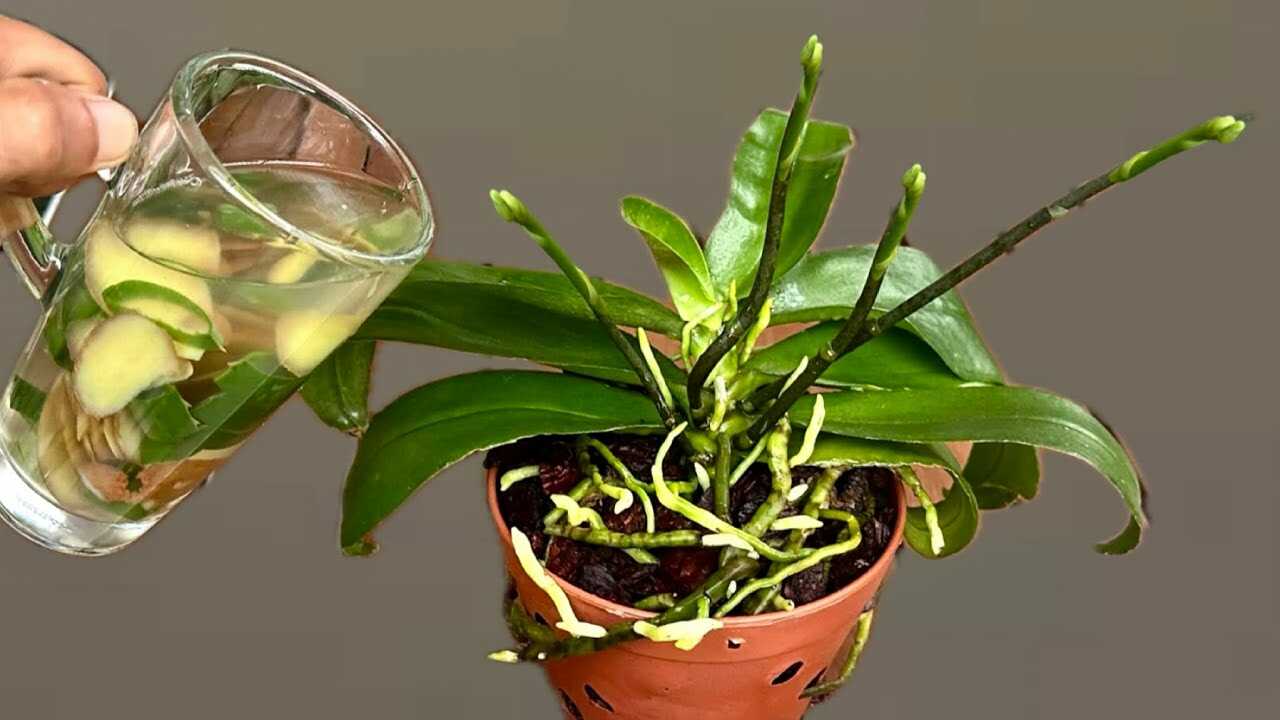
In the photo you can see a clear jug full of sliced **fresh ginger** being poured toward an orchid in a bark pot — the visual cue we’ll use as the central tip. This article explains a safe, evidence-based way to use a **ginger infusion** as a supplemental drench for phalaenopsis and other potted orchids to support root health and reduce surface pathogens. Remember: this is a complement to proper **light, watering and drainage**, not a miracle cure.
Why ginger? The botanical rationale
Fresh ginger (Zingiber officinale) contains phenolic compounds such as **gingerol** and other volatiles with well-documented **antimicrobial and antifungal** activity in laboratory studies. While ginger is not a complete fertilizer, its extracts can help reduce surface fungal pressure around roots and may provide trace minerals that are beneficial in small amounts. Used correctly and diluted, a ginger infusion can be a gentle protective drench for orchids during active growth.
Step-by-step: How to make and apply a ginger infusion for orchids
- What you need: 5 g fresh ginger root (about 2–3 thin slices or 1 teaspoon grated), 1 liter clean lukewarm water, a jar or jug, a strainer, a measuring cup.
- Prepare the infusion: Place the sliced or grated ginger in 1 liter of lukewarm (not hot) water. Let steep for 12 hours at room temperature. Strain out the solids — you want a clear infusion to avoid debris in the pot.
- Make the working solution: Dilute the strained infusion at a ratio of 1:4 (one part infusion to four parts plain water). This reduces the concentration to a safe level for delicate orchid roots.
- Application volume: For a standard 12 cm (4–5 inch) orchid pot, pour 100–150 ml of the diluted solution evenly onto the potting medium so it flows through the bark and out the drainage holes.
- Frequency by season: During active growth (spring–summer): apply once every 2 weeks. During slower growth (autumn–winter): apply once every 4–6 weeks. Always allow medium to dry slightly between waterings per your usual schedule.
- Observation window: Expect to notice firmer, healthier roots or reduced surface fungal spotting over 6–12 weeks when combined with proper care. Flowering responses take longer and depend on light and nutrition.
Practical tips from experience
- Avoid the crown: When drenching, keep liquid away from the leaf crown to prevent crown rot. Pour so the liquid goes into the media around the roots only.
- Use good medium and drainage: This method works best with open, fast-draining orchid mixes (bark, charcoal). A healthy medium amplifies any benefit from the infusion.
- Keep it fresh: Make a fresh infusion every 7–10 days. Discard any liquid that smells off or becomes cloudy from microbial growth.
- Combine, don’t replace: Continue a balanced orchid fertilizer program (dilute fertilizer every 2–4 weeks during growth). The ginger infusion is complementary and not a substitute for macro- and micronutrients.
Common mistakes to avoid
- Too concentrated: Pouring undiluted ginger extract or using large amounts can irritate roots and upset the pot’s microflora. Always dilute as directed.
- Poor sanitation: Reusing a jar or utensils without washing can introduce microbes. Clean equipment thoroughly between batches.
- Wet crown/foliage: Wetting the crown regularly encourages rot. Direct applications to the medium only.
- Skipping basic care: Expecting ginger infusion alone to induce constant flowering is unrealistic. Without correct light, temperature and nutrients, orchids won’t rebloom reliably.
How to tell if it’s working
After consistent use for 6–12 weeks, look for plumper, green aerial and substrate roots, fewer blackened root tips, and less visible fungal white powder or slimy patches on the bark surface. Flower spike initiation and improved bloom frequency usually require appropriate photoperiod and fertilization too, and may take 2–4 months to become evident.
Final encouragement and call to action
If you like the gentle, natural approach shown in the photo, try the diluted ginger infusion as a seasonal supplement and monitor your orchid’s roots and overall vigor. Keep a simple log (date, amount applied, visual notes) so you can see changes over several weeks. Share your results and adjustments — gardeners learn fastest by observing carefully and iterating. Happy growing!